

He’s six-two, weighs 330 pounds, and has arms that stretch wider than a car
But the NFL doesn’t want this guy in its lineup.
BY THE NUMBERS, ATLAS is a hydraulically powered robot in the form of an adult human. Here’s ATLAS, by the numbers:
Weight (incl. powerpack): 330 lbs
Height: 74”
Shoulder Width: 30”
Number of hydraulic joints: 28
Other features: Crash protection, modular wrists, LIDAR, stereo sensors
Defense contractors on Thursday unveiled one of the most advanced humanoid robots ever built as part of the DARPA Virtual Robotics Challenge in Waltham, Mass.Called ATLAS , the giant is controlled by a human operator, who guides the sensors, hydraulics, and limbs through a range of natural motions, the military said.
He can walk up stairs, stay upright after getting hit with heavy weights, and climb over or around obstacles in his path — and may ultimately boost the ability of first responders in a disaster scenario.
Related: Giant robots, monsters invade theaters
“We have dramatically raised the expectations for robotic capabilities with this Challenge, and brought together a diverse group of teams to compete,” said Gill Pratt, program manager for the DARPA Robotics Challenge.
And ATLAS is just one of the robots in the military’s latest robobuilding contest.
“The Virtual Robotics Challenge was a proving ground for teams’ ability to create software to control a robot in a hypothetical scenario. The DRC Simulator tasks were fairly accurate representations of real world causes and effects, but the experience wasn’t quite the same as handling an actual, physical robot,” Pratt said.
“Now these seven teams will see if their simulation-honed algorithms can run a real machine in real environments. And we expect all teams will be further refining their algorithms, using both simulation and experimentation.”
Say hello to ATLAS, one of the most advanced humanoid robots ever built!
ATLAS was developed for DARPA by Boston Dynamics. Software-focused teams from Tracks B and C of the DARPA Robotics Challenge will use the robot to compete in the first physical competition of the Challenge in December 2013 at the Homestead-Miami Speedway.
The DARPA Robotics Challenge seeks to advance the technology necessary to create robots capable of assisting humans in disaster response.
For more information on ATLAS and the Challenge, please visit http://www.theroboticschallenge.org.
PACIFIC RIM REVIEW: IT’S GIANT ROBOTS AND MONSTERS, DON’T OVERTHINK IT

If the idea of giant robots punching giant Godzilla-like monsters in the face doesn’t entice you even a bit, then we can’t be friends. Go ahead and stop reading this article now. Remove me from your friends list or Twitter feed, and may God have mercy on your poor, sad soul. Pacific Rim is not a “smart” movie. It won’t make you cry, nor will it make you wonder about the meaning of life. You won’t leave the theater and tearfully call your loved ones with a heightened awareness of your own mortality. No, Pacific Rim is about giant robots and monsters. It’s like someone gave a really talented 14-year-old boy a camera and a huge budget, and I mean that in the best way. Going into the movie, I joked that I would be disappointed if there wasn’t a massive robot battle within 10 minutes, I was walking out. I think it was probably closer to five minutes before the first robot appeared. From that moment on I relaxed, fully aware of the type of movie I was in for. Director Guillermo del Toro is an obvious anime fan, but you don’t have to be to appreciate Pacific Rim. All you really need to know are the story basics: A rift to another universe opens in the Pacific Ocean, and monstrous Kaiju (colloquial Japanese for “giant monsters”) of increasing strength have been pouring out for years. The governments of the world join forces to combat the new menace, and the “Jaeger” robots are born. The setup is handled quickly and efficiently, and a short montage accompanied by a voice over summarizes the world by the year 2020. Everything you see is rich with depth and color, from the rusted base of operation to the ruins of Tokyo.
If you do happen to be an anime fan, the movie will resonate on a very personal level. There have already been plenty of comparisons between Pacific Rim and Neon Genesis Evangelion. Both feature giant mechs controlled by humans, both feature increasingly powerful Kaiju. You could also just as easily draw parallels to Gundam, Code Geass, Big O, or dozens of others. Just don’t confuse similar setups with similar stories. Where Evangelion developed into a story involving deep religious themes and psychology, Pacific Rim has giant robots with rocket-powered elbow punches. The story is more universal than any one anime tale, and it is easily accessible to everyone.
The conflict between the Kaiju and humanity is the driving force of the film, but its heart rests with former Jaeger pilot, Raleigh Becket (Charlie Hunnam). Years after leaving the program behind, he is brought back into the fold by the Jaegers’ commanding officer, Stacker Pentecost (Idris Elba), to help mount what is fast becoming the last stand of humanity.
The Jaegers are too much for any one human to control, instead requiring two pilots to “drift” together, linking their minds and memories to function as one. This nuanced concept could have easily derailed a movie that shouldn’t ask you to think, but thankfully it doesn’t. It’s used more to highlight the difficulties that Raleigh’s new partner, Mako Mori (Rinko Kikuchi) has in piloting a Jaeger. If Becket is the film’s heart, Mori is its soul.
The rest of the characters in the cast are generally in it only for brief flashes, but they make the most of it. Charlie Day and Burn Gorman offer a touch of eccentric comic relief as scientists working on the Kaiju problem, while Ron Perlman’s Hannibal Chau is underutilized, but does a lot with what he is given.


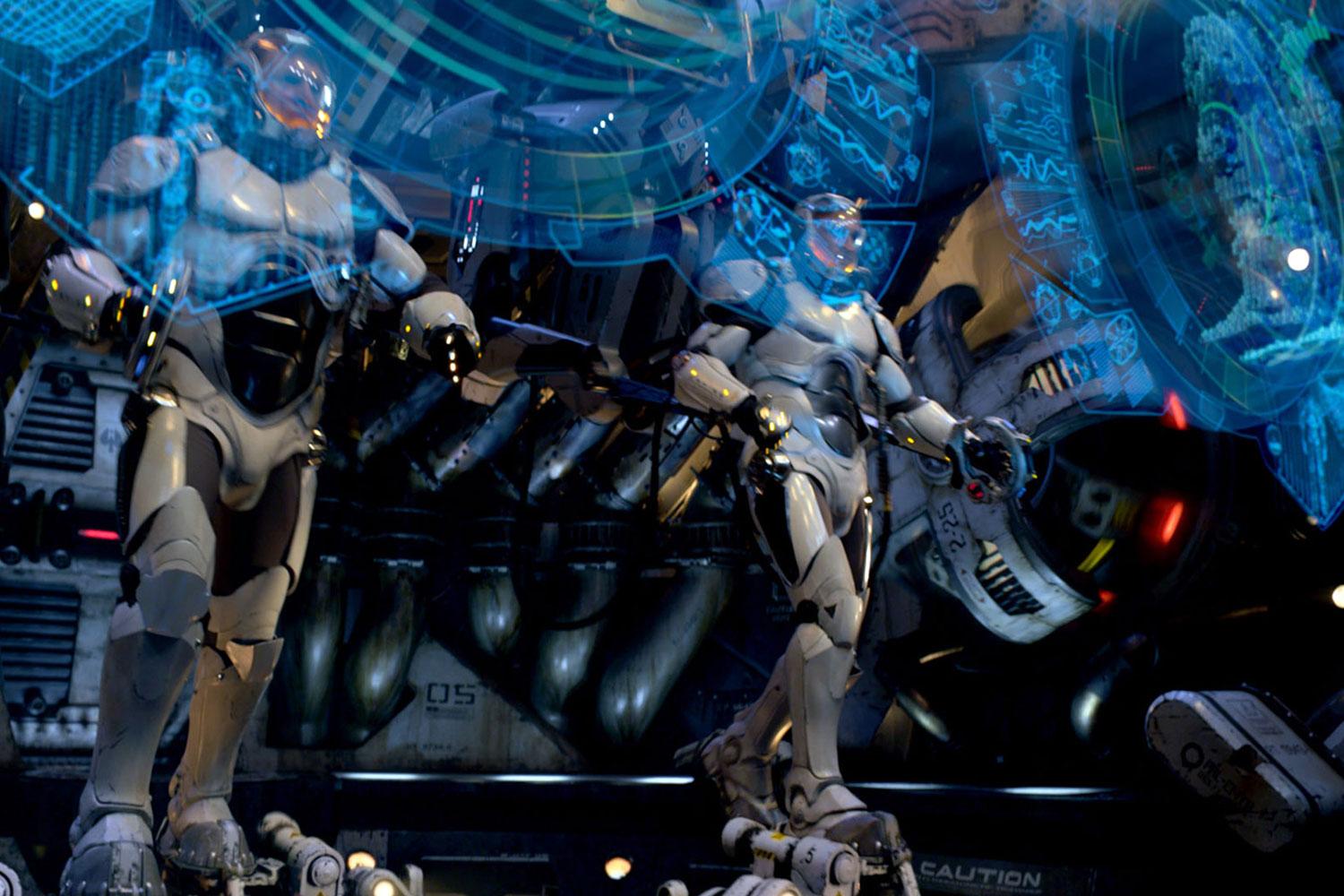

There are a few moments between fights when the film drags, but they are over soon enough, and the cast typically is likable enough to carry the story through the slow parts – especially Hunnam and Elba, who both excel with fairly stereotypical characters.
The story and even the acting is all secondary, though. No one in the world will go see Pacific Rim because they are interested in Charlie Day’s character arc. They will go for the spectacle, and they won’t be disappointed.
Del Toro chooses every shot with care, and nothing is left to waste. Everything you see is rich with depth and color, from the rusted base of operation to the ruins of Tokyo. There are no simple backgrounds. Even the scenes featuring the ocean are teeming with detail and color. Despite a flurry of activity in every shot, it rarely feels confusing to watch (with a few minor exceptions). The music doesn’t fair quite as well, but it is more forgettable than bad.There are plenty of moments that are just so ridiculously over the top that they are awesome, and should leave you with a smile on your face.
Conclusion
Pacific Rim is an unabashed action movie built on spectacle with an epic scale. The story is serviceable, and the cast makes the most of what it is given, more than enough to keep you invested until the next big set piece. Don’t go in expecting a lot of depth and you won’t be disappointed. Instead you may find the best popcorn movie of the summer.
The DARPA Robotics Challenge (DRC) is a prize competition funded by the Defense Advanced Research Projects Agency. Held from 2012 to 2014, it aims to develop autonomous humanoid robots that can do complex tasks in dangerous environments.
I’ve been working on the DARPA Robotic Challenge since December 2012 as part of the University of Delaware team focusing on developing various vision algorithms for event 1 autonomous driving:
 Our platform is called DRC-Hubo Beta, which is a modified version of the KAIST Hubo2 robot with hardware retrofits and software algorithms for autonomy. Our team consists of ten universities focusing on 7 different events, including driving (UD), rough terrain walking (OSU), debris removal (GT), door opening (Swarthmore), ladder climbing (IU & Purdue), valve turning (WPI) and hose installation (Columbia):

This set of complex tasks requires seamless integration between vision, motion planning and hardware control. Therefore, Drexel University invites students and professors from different institutions to join the ‘DRC Boot Camp’ and work together in the Philadelphia Armory for about 6 weeks in the summer.

My work is mainly focused on machine vision, including CPU/GPU based stereo matching and point cloud generation, CAT/Kin-Fu based model making, RVIZ interface development and so on. In the last 6 months, a lot of new software packages have been developed and pushed to the ROS repository. Also, many new hardware components and control methods have been made and implemented to this particular project. Considering the influence of past DARPA Grand Challenges, this event may become a turning point in the development of robotic technology (especially humanoids) for the next 5 to 10 years. The KAIST Hubo robot has been in development since 2003 and its more well-known counterpart, the Honda ASIMO, represents almost 40 years of study on bipedal walking:

However, these robots emphasize more on mechanical design and manufacturing precision rather than visual information processing and real-time closed-loop control/stabilization. It was not until recently did we see the Boston Dynamics ATLAS (The Agile Anthropomorphic Robot), being provided as Government Furnished Equipment for the DARPA Robotics Challenge program Track B teams:
This robot shows perfect combination of sensing and control, and it only takes them less than a years to develop the prototype from PETMAN after they get the $10.9 million contract from DARPA in August 2012. This is an example of how the DRC project speeds up robotic hardware development. Hopefully, with the amazing creations, imaginations and explorations from different teams/organizations throughout this whole project, robotics technology can really be pushed forward.

Related articles
- Ubuntu Used to Design and Control the Atlas Humanoid Robot for a DARPA Challenge (news.softpedia.com)
- Atlas Walking Over Randomness (i-programmer.info)
- DARPA Robotics Challenge trials to be held December 20-21 (gizmag.com)

 domhertz.com