
Hackers find hole in Google Glass security
-
 The Google Glass, the wearable computer being developed by the search giant, might be a threat to its owners’ privacy.
 -
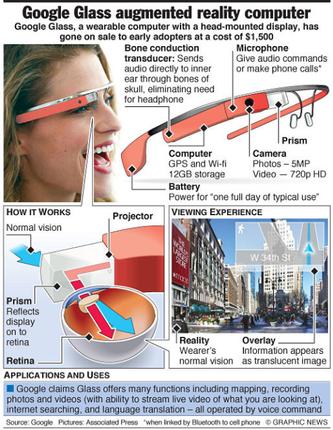
Graphic NewsGraphic shows how the Google Glass system projects information directly onto the retina, allowing users to see a small computer screen inset into the upper right area of their vision.

Augmented reality glasses could be compromised by a hacker who would be able to see and hear everything the wearer does
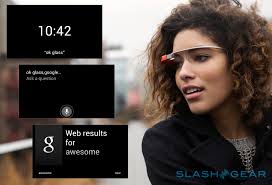
Google Glass, the wearable computer being developed by the search giant, might be a threat to its owners’ privacy because it has no PIN or authentication system, hackers have discovered.
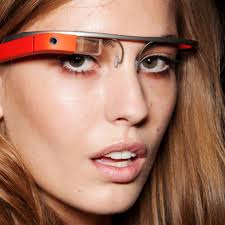
Jay Freeman, a Santa Barbara-based programmer who specialises in cracking smartphone security for both iPhone and Android devices, discovered that Glass has a “root” capability which can be enabled by attaching it to a desktop computer and running some commands. That would then give a hacker the ability to take control of the Glass’s output — meaning a hacker could monitor everything the owner was doing from a smartphone in their pocket.
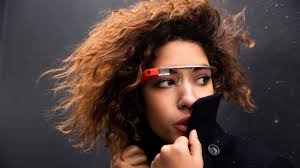
“Once the attacker has root on your Glass, they have much more power than if they had access to your phone or even your computer: they have control over a camera and a microphone that are attached to your head,” explains Mr. Freeman in a blogpost.

“A bugged Glass doesn’t just watch your every move: it watches everything you are looking at (intentionally or furtively) and hears everything you do. The only thing it doesn’t know are your thoughts.” He points out that “it knows all your passwords, for example, as it can watch you type them. It even manages to monitor your usage of otherwise safe, old-fashioned technology: it watches you enter door codes, it takes pictures of your keys, and it records what you write using a pen and paper. Nothing is safe once your Glass has been hacked.” Even if the device shows a red light to show others when its video camera is on, a user probably wouldn’t notice it — because the light would be facing away from them.
Mr. Freeman reckons that about 10 minutes would be enough for a hacker to install a “rooted” version of the software that Glass ships with. “Sadly, due to the way Glass is currently designed, it is particularly susceptible to the kinds of security issues that tend to plague Android devices,” he writes.
“The one saving grace of Android’s track record on security is that most of the bugs people find in it cannot be exploited while the device is PIN-code locked. Google’s Glass, however, does not have any kind of PIN mechanism: when you turn it on, it is immediately usable.” Mr. Freeman got hold of one of the demonstration units of Glass, and quickly found that there is a “Debug Mode” which lets it connect to computers over a USB connection. That in turn lets anyone who has access to the device to install their own software if they use certain technical tricks.
He recommends that Glass should have a protection system that functions when it is taken off by the owner, such as a biometric — either using patterns in the iris or voice — or a PIN.
And for the privacy concerns, both that users have expressed and that Freeman has now opened up, he suggests there would at least be a simple one over worries about the camera: a plastic shield that could slide over the camera. “This makes it clear that ‘I’m not recording right now’,” he suggests.
Google hadn’t responded to a request for comment ahead of publication.

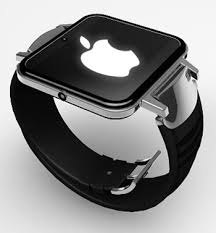
Google Glass, the augmented reality-enabled glasses, is likely to start retailing later this year. Apple’s iWatch, the pet project of ace designer Jony Ive, is also likely to be launched this year.
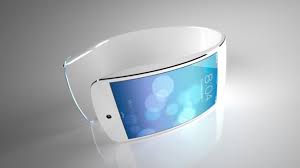
The two next-big-things could prove to be a major inflection point in the technology market.

The smartphone is so yesterday. And so is the tablet PC. For a generation that lives on instant gratification, these devices are fast losing their X factor.

So what is the next big thing?


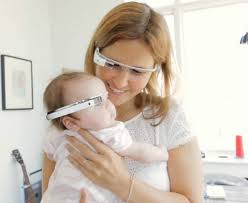

It could be Google Glass, the weird-looking augmented reality-enabled spectacles that the company hopes to sell by the million once it hits the retail markets later this year. Since last month, the company has been handing over the prototype to top technology blogs for trials and even opened up a window of opportunity for lay users to write to them on why they should be among the first to try it out.
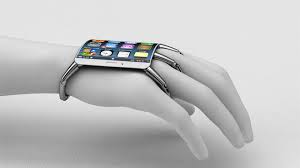
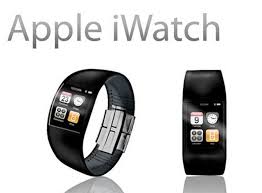
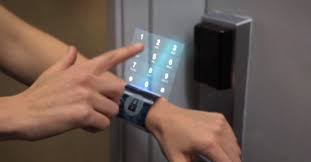
There are the usual rumours too surrounding Apple’s next big product. One that has been doing the rounds for some time is the long-in-development replacement to the wristwatch — the iWatch as it has been christened. A wearable intelligent watch that would replace the old faithful and provide more than just time-keeping services — add to that a pedometer, maps, health monitoring… the possibilities are many and exciting.
If the Internet buzz is anything to go by, a brand new genre of gadget could be headed to your living room by year end. Google has already said it has finalised its design for the Google Glass.
A looking glass and more
In an interview to technology blog The Verve, Google Glass product director Steve Lee and lead industrial designer Isabelle Olsson told technology writer Joshua Topolsky that the big mandate in front of them while creating the device was to create a technology that would help people stay connected and yet not feel distracted when they used it. And so the solution: a wearable glass computer that augments reality as and when one needs it. At other times, well, it is supposed to be a cool looking glass.

There are already several videos out on YouTube over the past month with several Silicon Valley-based technology bloggers having tried out the new technology, and there are also voices of concern that Google Glass could violate people’s privacy unlike any other device that’s available because of its always-on nature.
Google will need to build an Apps ecosystem surrounding the capabilities of Google Glass for the device to succeed. But it is not hard to see that happen. Already, in its various demos, Google Glass has been shown to be pretty handy with regard to mapping and imaging solutions.
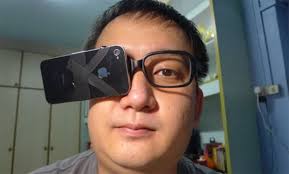
Although it would be weird to be in a room full of Google Glass-wearing nerds talking to their glasses: “Glass, do this, etc.” But the answers to that will be known for sure by next year, if as Mr. Lee succeeds in what he describes in the interview to The Verve, and puts out the device late this year or early next year.
Much-awaited iWatch
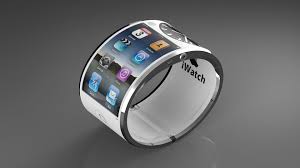
Apple’s much-awaited iWatch, on the other hand, seems more plausible as a recent report by business news agency Bloomberg put it. The watch industry is massive enough for a company on the scale of Apple to make inroads into. The Bloomberg report cited a number as big as $6 billion being the playing field should Apple enter it. Recent advances in curved glass technology and the possibility of leveraging on the iOS ecosystem all point in the direction of the guys at Cupertino possibly nailing this one. Of late, Apple has started lagging behind when it comes to innovations, with several people beginning to question the increasingly incremental improvements of its product line-up.

Samsung is already challenging Apple’s iPhone dominance. Now the South Korean electronics giant is eyeing another piece of Apple’s pie in what many regard as the next great mobile opportunity: smartwatches.
Just weeks following reports that Apple was working on a wearable wrist computer, Lee Young Hee, an executive vice-president at Samsung, toldBloomberg News on Tuesday that her company was also working on a watch-like device that would perform similar tasks to smartphones.

“We’ve been preparing the watch product for so long,” she said.
“We are working very hard to get ready for it. We are preparing products for the future, and the watch is definitely one of them.” Lee gave no details about when the watch would be available or how much it would cost.
Apple has declined to confirm or deny its smartwatch plans, but Bloomberg reports that it has more than 100 people working on the product with which it hopes to make inroads into the market for watches, estimated at 60 billion dollars per year.


 domhertz.com