

42 have died in clashes this month,
but Ukrainian city’s Jewish community insists it is a place of tolerance

A woman stands on May 10, 2014 in the burned trade union building in Odessa, southern Ukraine, as people gather outside the building during an Orthodox ceremony to mourn the death of pro-Russian militants killed nine days earlier.
Although Ukraine has been charting a bloody course toward civil war for months, Irina Zborovskaya had always felt safe in Odessa.
Living in a cosmopolitan city where hate crimes are rare and a tradition of tolerance for minorities and dissidents prevails, many Odessites were lulled into a false sense of security by the absence of violence witnessed elsewhere in their country since November, when protests began that ultimately would lead to the ouster of President Viktor Yanukovych.
But that changed on May 2, when one of the worst bloodbaths to hit Ukraine in recent months erupted in downtown Odessa. Some 42 people died in street fights there between pro-Russian protesters and supporters of the Ukrainian government, many of them perishing after a building was set ablaze.
“Even after all that’s been happening in Ukraine, it had remained unthinkable to us that one Odessite could kill another Odessite like that,” said Zborovskaya, the director of the local office of the American Jewish Joint Distribution Committee.“In Odessa, there was more calm than in other places,” she said. “But now I cannot think of a single person here who isn’t worried.”
With its bubbling night life, progressive cultural scene and garden cafe culture, Odessa had remained mostly quiet throughout the upheaval that has engulfed much of Ukraine. The city’s Jews — estimates of their population range from 30,000 to 45,000 — saw almost none of the anti-Jewish violence that accompanied the chaos in Kiev, where four serious assaults of Jews have occurred since November. In two eastern Ukrainian cities, unidentified individuals tried to torch synagogues. But since May 2, the Jewish community of Odessa has been partially paralyzed. While the new Beit Grand Jewish community center is open for regular activities, all special events have been canceled.
The center is home to a kindergarten located about 100 yards from where hundreds of protesters stormed a police headquarters on May 4. The suspension will continue until at least May 25, when Ukraine is due to hold its first elections since the revolution.
“It’s not safe to have people gather in one place right now,” Zborovskaya said.
It appears that no Jews have died as a result of the violence in Odessa, but the eruption has led to reports that local Jewish community leaders were working on an emergency evacuation plan for the city’s Jews.
Berl (Boleslav) Kapulkin, a spokesman for the Jewish community of Odessa, said the reports, which appeared last week in the Israeli media, were the result of a misunderstanding. The community has no immediate evacuation plans, Kapulkin said, but there are discussions underway about evacuating in the future if the situation escalates.

“If the conflict will grow here into a real war, we, together with all the [Jewish] community, will leave,” Kapulkin said. “But we pray that this does not happen and that God gives peace to Ukraine.”
Talk of evacuation was particularly shocking given that many see Odessa as the site of a Jewish cultural revival. Since 2010, the city has held four Limmud Jewish learning conferences with hundreds of participants. The community is also about to open its second Jewish museum; the capital Kiev has none.
“We hope this growth will continue,” Zborovskaya said, “but right now it is hard to make predictions.”
According to the Jewish Agency, 762 Ukrainian Jews immigrated to Israel in the first quarter of 2014 — an increase of 52 percent over the average of 500 people who immigrated in the corresponding periods of 2009 to 2013. In that period, Israel saw the arrival of 1,900 immigrants on average per year from Ukraine, according to Israel’s absorption ministry.

But many Ukrainian Jews have decided to stay despite the hardships and insecurity, said Tzvi Arieli, a former Israeli soldier who lives in Kiev and recently set up a small Jewish self-defense unit there.
“Those who wanted to come, came,” Arieli said in reference to the mass immigration to Israel in the 1990s of hundreds of thousands of Ukrainian Jews and their family members. “Those who stay, they want to stay.”
One who has resolved to stay is Pavel Kozlenko, the 43-year-old head of the Odessa Holocaust Museum and future director of the city’s second Jewish museum. Kozlenko said local Jews are bound to their city by their rich history. Before the Holocaust, there were 200,000 Jews in Odessa, constituting a third of its population, according to Yad Vashem.
Kozlenko said he wouldn’t leave Odessa, even though he was shocked by the recent violence.
“I can’t reconcile what I saw with my belief in this city of tolerance, which is home to more than a hundred nationalities, which produced such outstanding personalities of science, culture and art,” he said. “I thought such events could not happen here.”
5,000 years later, the wheel gets an Israeli update
With a flexible shock absorption system built into the wheel itself, SoftWheel boosts stability without sacrificing speed — in wheelchairs, bikes, cars, even planes
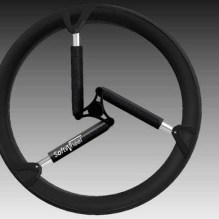
 SoftWheel, an Israeli company, is giving a high-tech update to the wheel, the ancient engine of civilization that enabled humans to explore their world.
Its new technology, focused around a flexible shock absorption system built into the wheel itself, allows for better stability when needed without sacrificing speed. “With all due modesty, I say that what we have created is a game changer,” said Daniel Barel, CEO of SoftWheel. “Our wheel technology can be developed for and retrofitted to any vehicle,” notably including bikes, cars and jet planes.
The airline industry is already in touch with SoftWheel, and the company sees immense potential there. But planes and automobiles will have to wait a while, Barel said, as the Israeli firm is focused first on wheelchairs and bikes.
“People in the airline industry heard about what we were doing, and asked us to develop landing gear incorporating our technology,” said Barel. “We weren’t sure it could be done at first, but, after doing some work on the project, we became convinced that it could be done, and could save airlines lots of money. We’re now developing the landing gear system, which will eliminate the need for the expensive hydraulics currently used to ensure that a plane lands properly. This technology has not been updated in sixty years.”
Still, in planes and cars, “it takes years to make changes. They have to be approved and implemented, factories have to adopt new manufacturing techniques, and so on,” said Barel. Much better to start with the wheelchair and bicycle markets, which are easier to break into. “Most of the world’s wheelchairs are used in hospitals, but there is a large premium market for people who want to live active lives but are restricted to wheelchairs by their disabilities. These people want to be as mobile and self-reliant as possible, and our technology makes this possible,” said Barel.
Barel sees bikers embracing the SoftWheel. “Our wheel will enable bikers to ride faster and more smoothly,” he said. “In standard wheels, about 30 percent of propulsion energy is reserved for suspension, even if that suspension isn’t necessary at a specific time. With our system, suspension can be turned on and off as needed, reserving more energy for speed.”

The oldest wheels found are about 5,000 years old from Mesopotamia, and it’s on that basic technology that modern wheels roll. What Barel and a team of engineers from Ziv-Av, an Israeli engineering firm, are doing entails a reimagining of the wheel — with a system redesign that incorporates shock absorption that turns itself on when necessary. The system, called Symmetrical Selective In-Wheel Suspension, uses sensors and three compression spokes to hold the wheel in place. When it encounters an impact, the wheel’s hub shifts, with the shock absorption cushioning the impact. The threshold can be preset by the manufacturer or user. Once past the impact, the wheel returns to its previous rigid state, saving the energy normally reserved for impact absorption in standard wheels and enabling it to be used for propulsion instead. Generally, only very high-end wheelchairs have shock absorption built in, necessitating wheelchair-accessible entrances to buildings. “It’s difficult and painful to use a wheelchair to cross the street, with the chair’s rider feeling the strong impact of a chair going off the sidewalk and onto a curb,” said Barel. “With a SoftWheel-equipped chair, a wheelchair user can cross streets or go down steps without feeling the impact.”
Bikes, both manual and electric, are another big market for SoftWheel, which employs six people and is located in the Haifa area. “With cities around the world implementing biking programs for commuter, there is a big market for more comfortable rides,” said Barel. “Our wheels can easily replace the standard ones used for bikes, and make bike commuting much more comfortable.”
For wheelchairs and bicycles, adding SoftWheel suspension is all about increasing energy efficiency and making the ride much more comfortable. For the car and plane markets, the system will be able to save manufacturers a lot of money, Barel predicts. “The bigger the vehicle, the more suspension you need, and both cars and planes have elaborate suspension systems,” said Barel. “In order to make up for the energy expended on the suspension, engines have to be made to work harder, using more fuel and resources. With our sensor-based technology and the suspension system built into the wheels, you can save a lot of fuel.”
Ditto for cars, said Barel, although implementing the SoftWheel system in planes and cars won’t happen overnight. “Plane designs have to be approved by the Federal Aviation Industry in the US, and implementing changes in the automobile industry takes time. But eventually, both industries are going to adopt our design. Until now you had to choose between comfort and efficiency in wheel design, and now, for the first time, you can have both.”If the SoftWheel catches on in the way Barel thinks it will, Israel will become a world center of wheel technology and production. “Nearly all the materials we use to produce our wheels are made in Israel, and we are currently building a large production facility in northern Israel to build SoftWheels,” said Barel. “This, like our product, is an innovation as well, because not too many industrial products are made in Israel. All around we are developing a new paradigm, one we believe the world will embrace.”

 domhertz.com