

‘We regard this attack with utmost severity
says army spokesman; incident follows recent Gaza rocket strikes!
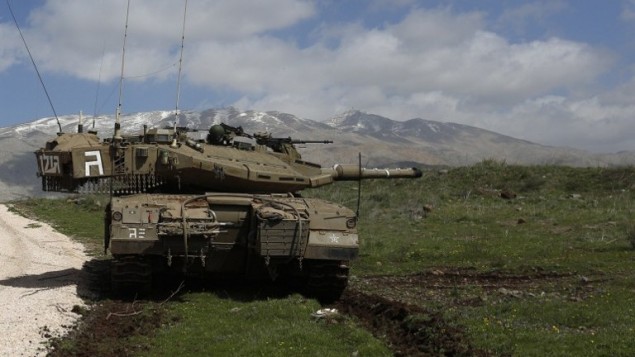 Israel hit back at a target in Syria early Monday morning after a mortar shell from the war-torn country hit Mt. Hermon.
“This attack is a blatant violation of the sovereignty of the State of Israel,” said IDF spokesman Peter Lerner.
“We regard this attack with utmost severity,” he added.
He initially indicated that Jerusalem would file a complaint with the United Nations Disengagement Observer Force, but later retracted that claim.
The incident followed an IAF strike on two targets in the Gaza Strip earlier Monday morning after two rockets from the Hamas-ruled territory hit open areas in southern Israel.
The Israel-Syria border region has seen intermittent exchanges of fire throughout the war in Syria.
Although Israel has largely cited stray fire from lashes in Syria in these incidents, there have been attempts to target Israeli soldiers.
In May, four IDF soldiers were injured by a roadside bomb in the Mt. Hermon area.
That incident occurred outside the Druze town of Majdal Shams, after the soldiers apparently spotted a suspicious person near the border fence and approached to investigate. In March, two Katyusha rockets were fired at the Israeli Hermon area.
IAF strikes two Gaza targets in response to rocket fire
Sorties come days after two projectiles hit Israel in recent days.
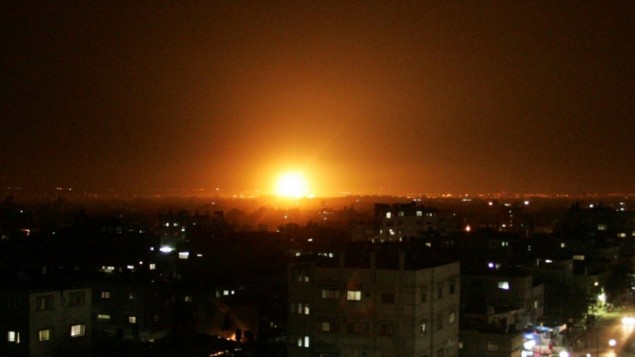
An explosion is seen following an Israeli airstrike in Rafah, in the southern Gaza Strip in 2014
The Israeli Air Force attacked two targets in the Gaza Strip early Monday morning, in response to recent rocket fire from the Hamas-ruled territory into Israel
One of the targets was in the southern Strip, and the other in the center. The IAF reported direct strikes on the targets.
Two rockets were fired into Israel in the last two days, including one which landed in an open area in the Eshkol Regional Council, causing no injuries or damage.
“This morning’s IDF actions are a direct response to Gaza terrorist aggression against the citizens of southern Israel,” said IDF spokesman Peter Lerner.
“The unlawful Gaza rocket attacks, meant to terrorize, maim and kill Israelis will not be allowed to become routine. We will fulfill our obligation to protect Israel and seek out and destroy the capabilities of those who wish to attack us.”

This image, made from a video posted on September 18, 2013, shows Syrians in protective suits and gas masks conducting a drill on how to treat casualties of a chemical weapons attack, in Aleppo.
Opposition figures have accused the Syrian regime of hiding chemical weapons in remote Alawite regions of northwestern Syria, defying its international commitment to eliminate its chemical stockpile by the end of June.
A senior member of the Syrian opposition who maintains contact with security officials still working for the Assad regime told The Times of Israel that on April 16, three vehicles arrived by night to Jourin, 100 kilometers (60 miles) northwest of Hama, where the regime’s Mountain Brigade was stationed. According to the officials, the vehicles were loaded with chemical substances, which were then buried underground within the brigade’s encampment.
Electricity was cut to the entire region as the cars arrived.
In addition, the sources reported, the regime has been transferring chemical substances and missiles carrying chemical warheads from a research center in the town of Marzaf, 20 kilometers (12 miles) northwest of Hama, to a converted recreation camp northeast of Masyaf, a town lying 50 kilometers west of Hama. The weapons were placed in secret caves and trenches in the mountain near the camp.
“According to our information, this is not the first time chemical weapons are moved from place to place,” the opposition member told The Times of Israel. “We believe the regime has hidden a large amount of VX (nerve agent) which is extremely toxic.”

Before agreeing last September to hand over his entire chemical stockpile to the UN, Bashar Assad held some 200 tons of VX, he added. “How much of this he has handed over, I do not know,” the oppositionist told The Times of Israel. The Times of Israel could not independently confirm the information, and the Organization for the Prohibition of Chemical Weapons did not respond to a request for comment, but an opposition activist from Hama said that in the early days of the Syrian uprising the camp — which contains tents, and a swimming pool and was used for civilian recreation — was converted into an enclosed military research center. The entire mountain behind the camp has also been surrounded by newly dug trenches, visible in satellite images of the area.
The new information confirms an Israeli report revealed by the Sunday Times in February, whereby Assad has been stockpiling missiles with chemical warheads in Alawite areas west of Hama.
Last week, UN Secretary-General Ban Ki-moon informed the UN Security Council that the June 30 deadline for totally eliminating Syria’s chemical weapons will not be met, because the Syrian government says the final shipment of dangerous chemicals can’t be transported safely
The UN chief
said in a letter obtained last Wednesday by The Associated Press that 7.2 percent of Syria’s declared chemical stockpile remains in the country. He said the government insists it doesn’t fully control security in the area where the chemical agents are stored and has “serious concerns about the safety and security” of convoys that will transport the material to the port of Latakia.
But the Syrian opposition member estimated that the regime is hiding “no less than 20 percent of its chemical stockpiles.”
“These 20 percent are enough to destroy the entire Middle East,” he said.
READ MORE ON: Syrian chemical weapons, Hama, Syrian opposition, Ban Ki-moon, OPCW Organization for the Prohibition of Chemical Weapons

 domhertz.com