

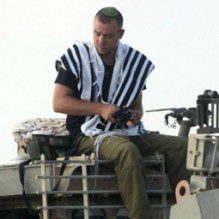
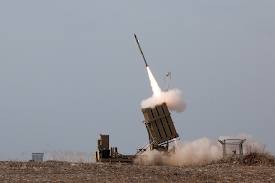
After dozens of rockets hit 40 km. into Israel, air force strikes dozens of Hamas sites; Hamas threatens to hit Tel Aviv; bereaved mother Fraenkel laments killing of Arab boy.
Israel launched a major operation against Gaza in the early hours of Tuesday morning, following heavy Hamas rocket fire on Monday. Meanwhile, condolences continued to pour in to the family of slain East Jerusalem teen Muhammad Abu Khdeir following the announcement Sunday that six Jewish extremists are suspected in the brutal killing; 3 of the suspects reenacted the killing, police said.
URGENT: Israel and Palestine Violence Escalates
The situation in Israel and Palestine is getting more volatile by the moment. Hamas has fired 130 rockets into Israel since midnight. Israel has called up 40,000 troops for a possible ground attack on Gaza in what it is calling “Operation Protective Edge.”
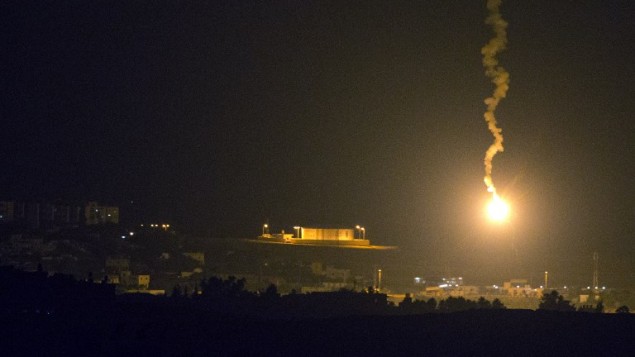
Exponential violence between Israel and Palestine

Recent days have seen an extreme escalation of violence and air attacks on Israel.
The discovery of the bodies of the three kidnapped Jewish teens led to a tragic retaliation by Jewish extremists in the kidnapping and murder of an Arab teen. Palestinian extremists in Gaza began firing rockets at civilian targets in southern Israel. Israeli Defense Forces responded with air strikes on Palestinian Gaza and communicated that an increase in attacks was coming. In response Hamas stepped up its rockets. As of Tuesday morning, 220 rockets have been fired at Israel since July 1. Israel has struck several Hamas targets – even telephoning one household warning them of an incoming attack.
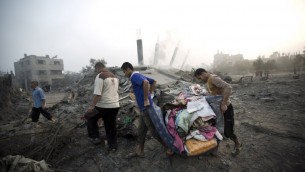
While Palestinians fire rockets into civilian areas, they condemn Israel’s “aggression” and accuse them of “massacres” against women and children, referring to the bombing of a Hamas operative’s house. Hamas declared that “all Israelis have now become legitimate targets.”

Please pray with us
The volatile scenario has grown exponentially in just a few days and now Israeli officials warn it could last a very long time. Please join us in praying:
- That God would bring a cease to the violence, not only in this urgent situation, but in the day-to-day living that harbors the seeds of such major engagements
- That civilians caught in the middle would be protected in both Israel and Palestine
- That Israeli leaders would have wisdom in their measures to protect their citizens
- That God would stop the extremist instigators whose actions sparked into flame the undercurrent of hostility between the people of Israel and Palestine
- That God would use this frightening reality to draw people to Himself – people on both sides of the fighting, as well as those caught in the crossfire, who need Him so desperately
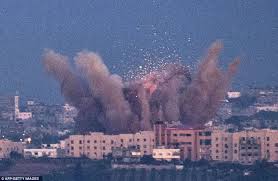
After dozens of rockets launch toward Israel, Israeli planes hit hamas positions in Gaza.

Hamas decides to go for broke Struggling to maintain the banner of ‘resistance’, the Gazan terror group is firing at Israel in the hope Ramallah and Cairo will hear its plea for help hamas’s decision to end a 20-month-long ceasefire with Israel last week was a result of the movement’s gradual decline over the past year, accelerated by the unity deal with Fatah which has left it teetering on the verge of collapse.
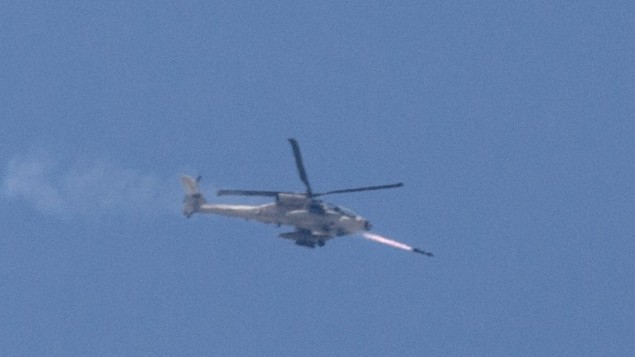
Isolated by Israel, shunned by Egypt and battered by Mahmoud Abbas’s Palestinian Authority in the West Bank, Hamas has decided to go for broke. True, it had used its massive missile arsenal with relative restraint as of Tuesday afternoon, but it nevertheless hopes that a new round of violence can reshuffle the deck and leave it with a better hand.

The Islamic movement’s distress calls — directed mostly at Ramallah — have intensified over the past week. With 44,000 Hamas civil servants out of work and without salaries as Ramadan began, Hamas foreign ministry official Ghazi Hamad convened a press conference on July 3 to warn that “the Gaza Strip is in grave danger and the unity government doesn’t care what’s happening here.”
Palestinian Authority Prime Minister Rami Hamdallah never called to ask about the situation in Gaza as it faced Israeli air strikes, Hamad charged, nor did the PA government allocate any budgets for the four ministries run from Gaza.
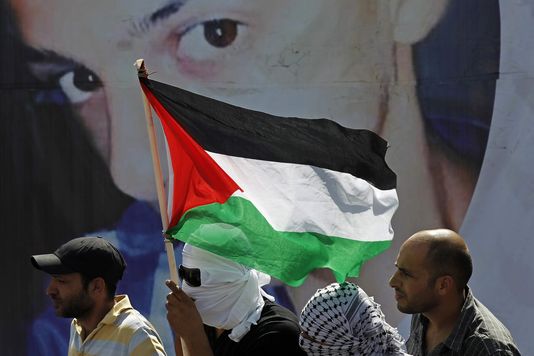
Politicians, Hamad was quoted by London-based Al-Quds Al-Arabi as saying, must find urgent solutions for a situation which is growing increasingly untenable. “The reconciliation is in danger,” he said.

Palestinian Authority Prime Minister Rami Hamdallah (R) is sworn in along with the new Palestinian unity government in the presence of PA President Mahmoud Abbas (L) in the West Bank city of Ramallah,
But Hamas’s call was not heeded.
On Tuesday afternoon, as operation Protective Edge was in full force, Hamas deputy political bureau chief Moussa Abu Marzouk said he was hoping that the conflagration in Gaza would inspire West Bankers to launch a third intifada.

“Today, we are all called upon for a popular intifada, an intifada for prisoner Jerusalem. Today, more than ever before, we are demanded to express our rejection of the occupation … we are sick of talk of resolutions and peace,” he wrote on his Facebook page.
Attempting to capitalize on the murder of Palestinian teenager Muhammed Abu Khdeir last week, allegedly by Jewish terrorists, Hamas political bureau member Izzat al-Rishq wrote that “such battles and intifadas are always sparked by the blood of heroic youth, and then adopted by the people.”
Meanwhile, on the Egyptian front, Hamas’s pleas have also fallen on deaf ears. The Rafah border crossing has remained largely shut for months, and Egypt continues to operate against smuggling tunnels unabated.

In a speech Monday marking the anniversary of the Yom Kippur War according to the Muslim calendar, Egyptian President Abdel-Fattah el-Sissi made no reference to Gaza; a fact that spoke volumes for the new regime’s attitude toward the Palestinian branch of the Muslim Brotherhood, which is classified as illegal under Egyptian law.
“No previous Egyptian president from the military has ever dared to ignore Israeli aggression against the Palestinians, neither before the Camp David [peace accords with Israel] nor after it,” claimed a TV report in Al-Jazeera, a staunch supporter of the Muslim Brotherhood and Hamas.
Israel, for its part, remains reluctant to provide Hamas with the satisfaction of a new intifada. It is bracing itself for a gradual escalation to match that of Hamas, but nothing more, for now. Nuclear talks with Iran reach their deadline in 12 days, and Israel would not want to see the world distracted from what it defines as its greatest existential threat — a nuclear Iran.
After days of tensions merely threatening to spiral out of control in Gaza, on Monday they finally did just that, with a massive barrage of rockets striking deep into Israel and a massive Israeli response on the strip overnight.
While most papers went to bed, along with the rest of the country, before the real fireworks show began in the Strip, the Hebrew print media is still chock full of information that remains relevant the morning after Israeli forces launched Operation Protective Edge.
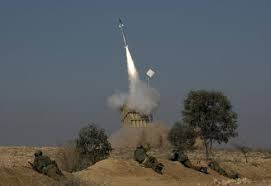
Both Yedioth Ahronoth and Israel Hayom seemed to have held back going to press to catch at least the start of the operation and its name (Tzuk Eitan, or firm cliff, for those keeping score at home) at about 1:30 a.m.
While Yedioth counts over 100 rockets fired at Israel from Gaza on Monday, Israel Hayom and Haaretz go with over 80 (closer to the official army tally).
Israel Hayom notes the spread of Hamas fire northward, out of the area immediately surrounding Gaza which it normally uses as its firing range, writing that as the day wore on “the list of cities taking on rocket volleys just expanded and grew.” The paper also reports, in what likely its last tidbit of information before editors finally called it a night, the unconfirmed reports that Israeli planes hit the home of Hamas leader Ismail Haniyeh in the Strip at about 2 a.m.
Despite the very late press time, Yoav Limor writes in the paper that as of early Tuesday it was still a low-level conflict and not a war, an assessment proved obsolete by late Tuesday morning as the cabinet ordered a wider reserves call-up and preparations for a ground war.
Still, he writes presciently, “It’s safe to assume that in the next few days the IDF will present pictures of tanks amassing near the Strip, some of the armored and infantry brigades that have gathered there, but the point will mostly be to threaten and deter.”

As is usual in situations like this (for better or worse), the press finds itself more apt to rally around the flag, an effect that’s cranked up to 11 by Nahum Barnea in Yedioth, writing that with the operation, Hamas is getting what it asked for.
“Hamas has done very much – 100 rockets is very much – to push Israel into Gaza. It has done this, almost certainly, out of despair, since according to its viewpoint, this is the only option left to it. Opposite it stands Netanyahu, one of the more restrained prime ministers the country has known when it comes to military matters.”
Haaretz, meanwhile, has its peace party pooped on by all the hubbub. The broadsheet stubbornly (or optimistically) sticks a column by US President Barack Obama (a major coup, as it would be for any newspaper), across the whole top of the fold on A1 to herald the start of its peace conference, relegating the Gaza conflict to second fiddle.
While some noted the irony of Obama’s op-ed in light of the renewed hostilities (Haaretz maintains it was written before June 30, though some changes were clearly made to reflect newer developments), the president clearly still has something to say about the current situation (which is just like the past situation, as is wont to happen in the Middle East), writing that while “walls and missile defense systems can help protect against some threats, true safety will only come with a comprehensive negotiated settlement.”
“As I said last year in Jerusalem, peace is necessary, just, and possible. I believed it then. I believe it now. Peace is necessary because it’s the only way to ensure a secure and democratic future for the Jewish state of Israel,” he (or more likely somebody in his employ) writes.
Obama’s op-ed does not mean the paper, which misses the launch of the operation, ignores the conflict with Gaza, though it downplays it significantly, if word count and page placement can serve as a barometer.
Amos Harel, writing in an analytical capacity, notes that both sides are playing chicken, with Hamas unlikely to blink first.
“Based on its public statements, Hamas is doubling down. Put another way, the sides are playing the most popular game in the region for years: “hold me back.” One side tries to convey that it will go all the way if its demands aren’t met, even if it’s doubtful that the side wants a clash. If a formula isn’t found soon, chances are we’ll see a further escalation.”
Yvette’s big nyet
The breakup of the Likud-Yisrael Beytenu partnership earlier Monday (ostensibly over the lack of a wide Gaza operation) also garners large headlines in the press.
Israel Hayom reports that Likud apparatchiks are not exactly happy with Liberman’s move, seeing through his claims that it has something to do with Gaza and viewing it instead as a political maneuver.
The paper notes that party members are worried the move could make it harder for Netanyahu to form a coalition next time, taking for granted that he will be elected prime minister when elections roll back around.
MKs, though, saw the announcement coming a mile away. “It was clear that from the moment Liberman understood he could not become part of Likud, he needed to find a way to break off,” MK Ze’ev Elkin is quoted in the paper saying. “Liberman needs the time to differentiate himself ahead of a campaign for the next elections. The question isn’t why it happened now, but why it didn’t happen before now.”
Yedioth’s Shimon Shafir assesses that although Yisrael Beytenu head Avigdor Liberman said his faction will stay in the coalition, the announcement could be the latest death knell for Netanyahu’s five-year rule.
“Political sources assess that the confusing behavior of the prime minister during the presidential election process and his aborted and failed attempt to change the structure of the country’s leadership signaled the beginning of the end. Liberman also apparently came to a similar conclusion and decided now was the right time to position himself as an alternative to Netanyahu,” he writes.


 domhertz.com
Wellensteyn Mit Taschen Gore-Tex
Companies cannot take the chance of turning off a lead due to poor lead nurturing.
J’aimeJ’aime