


The U.S. Navy’s new Zumwalt-class is the next-generation in destroyer technology.

On Monday, the U.S. Navy launched its radically futuristic new stealth destroyer – the USS Zumwalt. The ship is captained by the aptly-named Capt. James Kirk, and the first Zumwalt-class destroyer in operation. The Navy expects to ultimately deploy up to three Zumwalt-class destroyers. While the Zumwalt is the U.S. Navy’s do-everything ship in many ways, it was designed with land attack in mind. Given that the Zumwalt‘s overt design attempts to overcome China’s much-touted anti-access/area-denial (A2/AD) strategy, the launch of the ship will be closely watched by the PLA Navy.
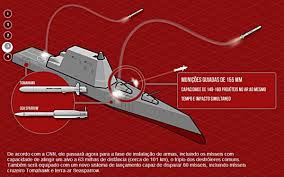
It’s considered to be a “next-generation” destroyer with a design that reduces its signature, and an incorporation of active and passive self-defense systems. It represents the culmination of over two decades of research and development. The Zumwalt in reality represents the very frontier of destroyers, and in actuality resembles a battleship in more ways than one. Most notably, its sheer size puts it at a few feet short of being classified as a battleship. The Zumwalt incorporates enough power to match its hefty size.

According to Navy Live, the U.S. Navy’s official blog, the Zumwalt incorporates an innovative power system:
« The ZUMWALT Class is the first combatant to introduce a Low Voltage Power System that features a highly survivable Integrated Fight Through Power (IFTP) system, which relies on new-to-the-Navy solid state Power Conversion Modules to achieve user-specific power demands. The IFTP architecture combines four electrically isolated zones (forward to aft) and two segregated longitudinal buses (port/starboard), with advanced Engineering Control System functionality that introduces single-operator control with unprecedented and reliable automated power management, fault isolation, and recovery features.”
The addition of the Zumwalt hones the U.S. Navy’s technical ability to make good on its Air-Sea Battle (ASB) strategy, including Joint Operational Access.
The ship’s next-generation offensive capabilities include expansion to incorporate rail gun and laser weapon technology. Experts credit the ship’s innovative power plant as enabling its offensive capabilities. Breaking Defense, in its coverage of the Zumwalt’s launch, brings attention to its additionally innovative approach to human systems integration. The Zumwalt also operates with a much smaller crew compared to other ships with its capabilities. Breaking Defense cites Scott Truver on the matter:
« When upwards of 70% of the total ownership cost (TOC) of an ship class is directly related to people, anything that can reduce manning — without diminishing warfighting-first and readiness capabilities, of course — will be major contributors to keeping TOCs in check. The DDG-1000 (Zumwalt) class is the first U.S. Navy warship to fully embrace the precepts of human systems integration in the design and engineering phase—when some 60 percent of a warships’ TOC (Total Operating Costs) are already locked in…. In short, lessons learned from Zumwalt have the potential to ripple throughout the service, generating a real revolution at sea!”
The development of the Zumwalt hasn’t been free of political controversy. In an era of tightening defense budgets and spending, the program came under fire from budget hawks in Congress who have found its return on investment value to be unsatisfactory.
But the ship also has its proponents on Capitol Hill. Rep. Randy Forbes (R-VA), chairman of the House Armed Services Seapower and Projection Forces Subcommittee and chairman of the Congressional China Caucus, has heralded the Zumwalt as precisely the sort of hardware the U.S. Navy needs to incorporate to ensure its dominance.
Zumwalt Class Destroyer SITREP
Recently, I mentioned my trips to Maine and Rhode Island to visit Bath Iron Works (BIW) and the Raytheon Facility. Both of these tours provided firsthand insight into the production of ZUMWALT-class destroyer, and latest system testing. Though brief when previously mentioned, I now want to provide insight into the DDG 1000 program, its current status, and notable highlights.
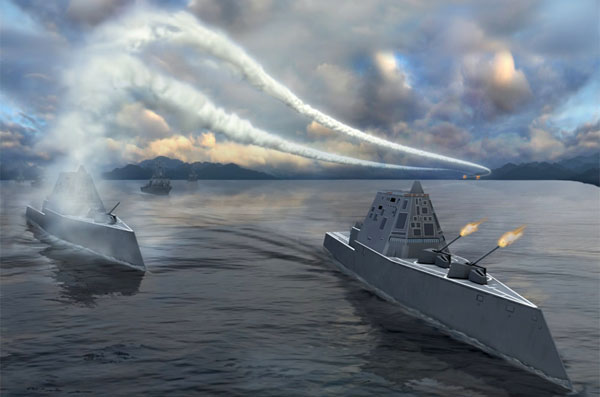
DDG 1000 culminates two decades of research and development, creating the next generation destroyer capable of defeating future threats. The revolutionary design of the ship itself reduces its signature and includes both active and passive self-defense systems, plus enhanced survivability features. The self-defense systems are built to defeat littoral submarine threats, next generation anti-ship cruise missiles, and small boats. Also, the USW suite is capable of in-stride mine avoidance. It will provide valuable lessons in advanced technology, which can be incorporated into other ship classes, and it will have optimal manning through Human Systems Integration. For example, the automation on DDG 1000 will allow most routine watchstanding to take place in only two locations – the Bridge and the double deck Ships Mission Center (SMC). The SMC will have the look and feel of an advanced command center with operations overseeing both ship missions and functions through multi-modal common display system workstations.
Physically, all three ships are under construction! ZUMWALT (DDG 1000) is more than 70% complete. Christening and Commissioning are set for FY13 and FY15, respectively, with a two-phase delivery for HM&E and Combat Systems scheduled for FY’s 14 and 15. Following Developmental and Operational Testing, DDG 1000 will IOC in FY16.
MICHAEL MONSOOR (DDG 1001) is more than 30% complete with Sail Away in FY17. Additionally, fabrication of DDG 1002 began 4 April with Senator Collins and CNO commemorating the event; of note, SECNAV named the ship LYNDON B JOHNSON on 16 April. All three destroyers are meeting major construction and testing milestones to reach completion prior to arriving in their homeport of San Diego.
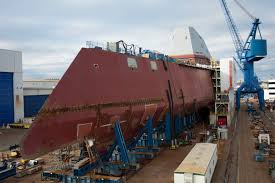
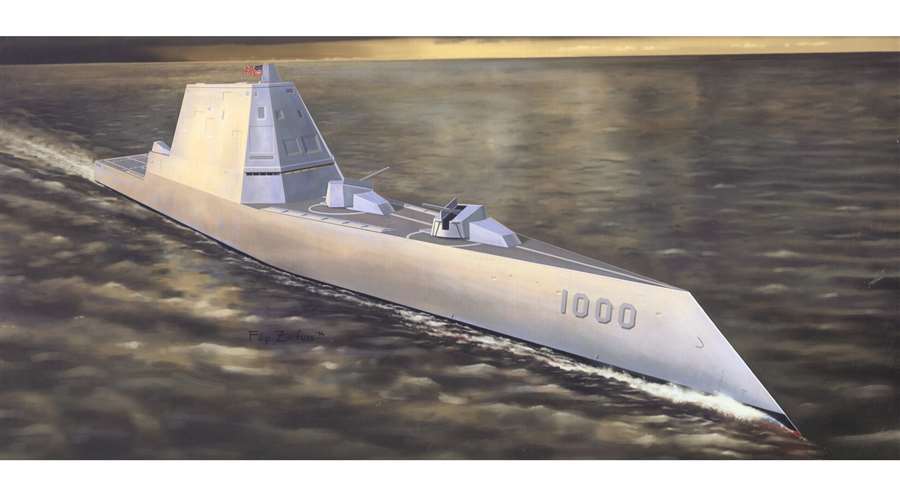
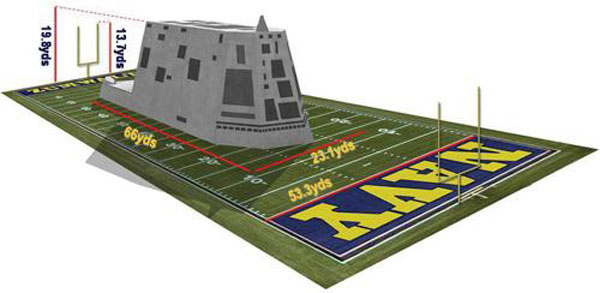
These ships are remarkable accomplishments of modern shipbuilding. In these ships you can see the teamwork between Sailors, civilians, and industry. Upon completion, the ZUMWALT class will be the largest destroyers ever built by the U.S. Navy. The total length will be 610 foot with an 81 foot beam, 27 foot draft, and a fully loaded displacement over 15,600 tons. By comparison to a football field, the composite deckhouse alone is 66 yards long, 23 yards wide, and almost 20 yards tall.
.
Physical size isn’t the half of it, the engineering plant is very impressive, as well! The Integrated Power System (IPS) is an all-electric power plant that generates the ship’s total distributable electric power while also converting this power for all ship loads, including propulsion, combat systems, and ship services. IPS’s design is centered on two Main plus two Auxiliary Turbine Generators producing a total of 78mW electrical power… 58mW of which is available when the ship is at 20kts!
One of the underlying strengths of the ZUMWALT Class is its innovative IPS design. It provides resilient combat power and extra margin for future capability growth within the ship, a critical attribute designed to help the Navy modernize elements of the ship’s combat capability and adapt to changing fiscal, technological, or threat conditions.

Additionally, the ZUMWALT Class is the first combatant to introduce a Low Voltage Power System that features a highly survivable Integrated Fight Through Power (IFTP) system, which relies on new-to-the-Navy solid state Power Conversion Modules to achieve user-specific power demands. The IFTP architecture combines four electrically isolated zones (forward to aft) and two segregated longitudinal buses (port/starboard), with advanced Engineering Control System functionality that introduces single-operator control with unprecedented and reliable automated power management, fault isolation, and recovery features.
The shipboard crew of ~130 Officers and Sailors will be berthed in staterooms ranging from 1 to 4 person occupancy, with an integrated bathing facility with each and every stateroom. DDG 1000′s crew screening and billeting process has already begun; the MPA and STO reported, while the Commanding Officer will be slated shortly. The remainder of the PRECOM crew for PCU ZUMWALT will continue to report through 2015.

Upon joining the Fleet, DDG 1000 will mark major advances in surface combatant capability. DDG 1000 is an optimally crewed, multi-mission surface combatant tailored for land attack and littoral dominance. ZUMWALT will provide offensive, distributed, and precision fires in support of forces ashore, and a credible forward naval presence operating independently or as an integral part of Naval, Joint, or Combined Expeditionary Strike Forces. Ultimately, DDG 1000 will provide significant capabilities to address deterrence posture requirements and the campaign plan needs of our Combatant Commanders. DDG 1000 will also help satisfy steady-state presence demands while, most importantly, supporting DoD’s Strategic Guidance and the Defense Secretary’s direction to sharpen the technological edge our naval forces which will serve in critical roles as envisioned by the Joint Operational Access and Air-Sea Battle Concepts.
I encourage you to read more about DDG 1000 in the Winter 2012 edition of Surface Warfare Magazine and in an upcoming edition of Popular Science.


 domhertz.com