

At Yad Vashem memorial, pope castigates humanity for Holocaust
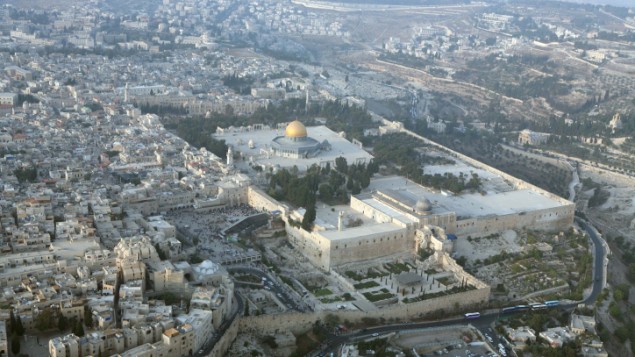
Francis embeds a note in the Western Wall, calls for greater interfaith dialogue atop Temple mount; roads closed throughout capital as ‘pilgrimage of prayer’ Middle East tour enters final leg.

Pope Francis is welcomed by Palestinian President Mahmoud Abbas in the West Bank city of Bethlehem on May 25, 2014.
day after a politically charged visit to Bethlehem that saw the pontiff pray at the security barrier and appear with Palestinian leader Mahmoud Abbas, Francis is spending his last day in the region touring holy sites in Jerusalem and meeting Israeli leaders. Follow the Times of Israel’s liveblog for all the updates.
Pope has ‘good feeling’ with Peres
Pope and Peres are now holding their private meeting before making public remarks at ceremony outside.

On Sunday, Francis invited Peres and Palestinian Authority President Mahmoud Abbas to visit the Vatican to pray for peace, and both accepted.
Officials say the meeting will take place on June 6.
A Vatican spokesperson told reporters the invite to Peres and not Netanyahu was not a slight, but a sign of the close friendship between the pontiff and the president.
“The pope has with President Peres a good feeling, this is clear,” the spokesperson said, according to The New York Times. “This is not an exclusion of the other, but there are good premises to pray together with President Peres and Mahmoud Abbas.”

Peres and Francis exchange gifts
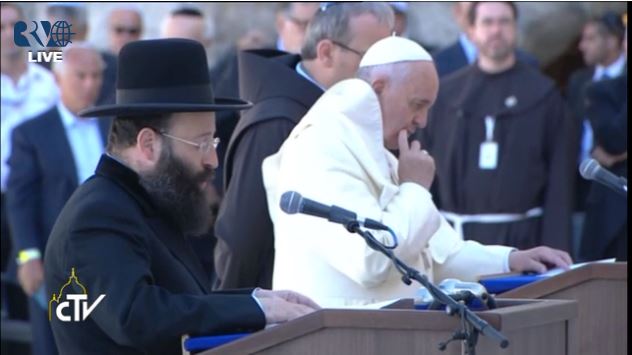
Peres sits with Francis, before the two quickly get up to inspect the mosaic, which shows an olive tree and doves for peace, as well as a fish, to represent Jesus.
Francis gives Peres a medallion representing the visit of Pope Paul VI, 50 years ago in 1964, which this trip commemorates.
“I thank you for your message of peace,” the pope tells Peres. “I feel very blessed.”
Peres thanks the pope, and the journalists, who are studiously watching every move of theirs.
After a quick trip, the pope arrives at the President’s Residence, where he is greeted by Peres and taken to see the group of sick children, who kiss his hands before he moves on.
He is then taken to sign the guestbook, sitting as camera flashes pop amid a large media presence.
Religious Affairs Minister Naftali Bennett posts a picture of himself on Facebook, writing that he told the pope that he sees the State of Israel as the realization of the biblical prophetic visions.
Plus, he writes, he noted that Francis had “kind eyes.”

After meeting the chief rabbis, the pope will now leave for a meeting with President Shimon Peres at his residence in the leafy Rehavia suburb.
While there, the two will hold a private meeting with Israeli and Vatican officials.
They will also give public remarks at a ceremony at the residence.
The pope will also meet with a group of sick Christian-Arab children whose wish to meet the pope is being made possible through the Make-a-Wish Foundation.

Pope calls for spiritual Jewish-Christian ties
Now the pope stands up to speak, saying he’s been able to count on Jewish organizations for support since his ascent to the papacy.
“I’m convinced that the progress that has been made in recent decades between Jews and Catholics has been a genuine gift from God,” he says.
He also notes the growing dialogue between the Chief Rabbi and the Vatican’s department for relations with the Jews, saying it is reaching its bar mitzvah and has a bright future.
He then calls for the bond to be investigated not just from a human angle but also spiritual.
“On the part of Catholics there is a sincere desire to reflect on the Jewish roots of our own faith,” he says. “I trust with your help among Jews too there will be a genuine interest in Christianity.”

“Together we can make a great contribution to the cause of peace,” he says.
Lau: Bolster Israel, where there is freedom of religion
Chief Rabbi David Lau speaks next, saying he wants to focus on the importance of life. “Even our most important commandments are pushed off if there is a life-and-death danger.” Lau says a few meters from here, people — women, children, babies — were killed. People from all religions took care of the wounded, he adds, without regard for religious.
He calls on the pope to convene an interfaith peace conference in Jerusalem, saying that there is freedom of religion in all areas under Israeli control.
“Strengthen Israel, strengthen the Jews against hate and anti-Semtism,” Lau urges the pope.
Chief Rabbi Yitzhak Yosef gives the first speech, zeroing in on the Ten Commandments and noting that the first five deal with relations between man and God and the second five, between man and man.

“It’s impossible to separate between man and God and man and his fellow,” Yosef says. Yosef then tells a Talmudic parable about a donkey and a gem with the moral that man must not be selfish, but share what he has.
“We believe there is a place for God, but also our fellow,” he says.
Bringing up Saturday’s Belgium museum shooting attack, he then thanks the pope for speaking out against anti-Semitism and says the church can help bring peace, “a real peace.”
« It is good to be with brothers and if they are older brothers, it’s even better »
Pope calls terror ‘absolute evil’
Lior Haiat, a diplomatic official organizing the pope’s visit, says Francis strongly condemned terror while at the terror victims’ memorial.

“Terror is absolute evil. It comes from evil and causes evil,” he quotes the pope saying. “Never again. Never again.”
While our liveblog offers up-to-the-minute coverage of Pope Francis’s visit, those who want a more live experience can tune into the Vatican news site’s video feed, which is following all the goings-on complete with English translations.

Pope Francis is presented with a book about Vatican-Jewish relations.
The group is then introduced to the various dignitaries in the audience.
Chief Rabbi Yitzhak Yosef thanks the pope for speaking against anti-Semitism and welcomes him to Jerusalem.
Turning to his right, the other chief rabbi, David Lau, tells Francis that Jerusalem has meaning for the three major monotheistic religions and says he hopes they can give peace to the world.
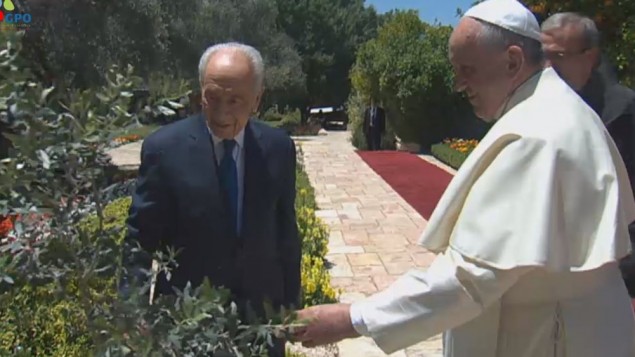
After leaving Yad Vashem the pope will now venture into the heart of west Jerusalem for visits to Heichal Shlomo with the country’s two chief rabbis, Ashkenazi rabbi David Lau and Sephardi rabbi Yitzhak Yosef.
The pope will deliver a speech there before a visit to the President’s Residence where he will speak with Shimon Peres.
Netanyahu releases a statement thanking the pope for visiting the terror victims’ memorial at Mount Herzl.

“I explained to the pope that the security fence prevented many more victims that Palestinian terror, which continues today, planned to harm,” Netanyahu says, referring to Sunday’s papal pause at the security barrier at Bethlehem.
The statement essentially confirms the suspicion that the stop at the memorial was intended as a response to Francis’s visit to the wall in Bethlehem, during which he offered a silent prayer.
The pope had said the trip would steer clear of politics, but it seems he has quickly found himself at the center of a tugging match between Israel and the Palestinians.
Pope presented with painting from Shoah victim
The pope takes several moments after his address, standing at the podium before stepping down and being presented with a replica of the painting “Prayer,” drawn by Holocaust victim Abramek Koplowicz when he was 13.
The choir then sings the Psalm “Mi Ha’ish” before the pope and his delegation leave.
The pope asks a series of questions of his fellow humans, who caused such tragedy.
“Who corrupted you, who disfigured you, who led you to believe you are the master of good and evil? Not only did you torture your brothers and sisters but you sacrificed them to yourself, because you made yourself a God.”
“Once again in this place we hear this voice of God. Adam, where are you?”
“A great evil has befallen us, as such that has never occurred,” he says.
“Grant us the grace to be ashamed of what men have done, to be ashamed of this massive idolatry.”
“Never again, Lord, never again,” he concludes.
Pope Francis ascends to the podium and stands silently for several moments before beginning his speech. “Adam, where are you, where are you, old man?” he begins, quoting Genesis. “In this memorial of the Shoah we hear this question once again,” he says.
Pope meets survivors
After hearing the solemn prayer of El Maleh Rahamim, traditionally said over the dead, Pope Francis kisses hands with six survivors: Avraham Harshalom, Chava Shik, Joseph Gottdenker, Moshe Ha-Elion, Eliezer Grynfeld, and Sonia Tunik-Geron.
The life stories of the six were published by Yad Vashem, each special in its own way, yet tragically typical of all of Europe’s Jews who lived through the Holocaust.

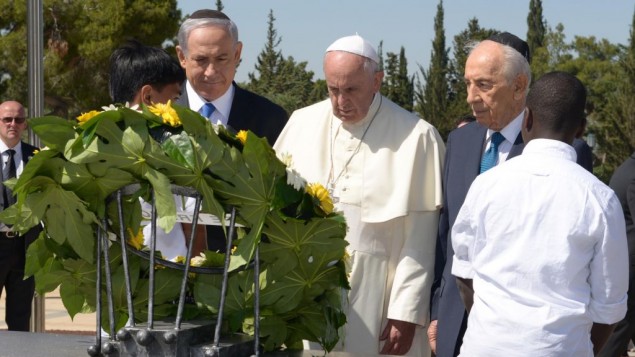
Pope Francis places a wreath at Yad Vashem, pausing for a moment to remember the victims of the Shoah.

The Ankor girls choir stands in the hall, solemnly singing a poem by Hannah Szenes, a Hungarian girl who escaped Budapest for Israel, then returned to Europe to rescue Jews before she was captured and killed. The haunting music gives the ceremony an otherworldly feel.
The choir was also on hand in 2009 for pope Benedict’s visit to Yad Vashem.

The pope enters Yad Vashem with his sizable delegation, including its heads Yisrael Meir Lau and Avner Shalev. Last pope’s speech at Yad Vashem ill-received. The pope is making the short jump to Yad Vashem, marking the most emotional part of the visit, at least for Jews closely following it. The last visit by a pope to the site, Benedict’s visit in 2009, drew some ire after the pontiff, who was a member of the Hitler Youth, was accused of issuing a “lukewarm” condemnation of anti-Semitism, according to a Haaretz report at the time. Rabbi Yisrael Meir Lau, the chairman of Yad Vashem and father of Chief Rabbi David Lau, who will meet Francis after the Yad Vashem visit, said Benedict’s speech refused to acknowledge the enormity of the Holocaust. “There’s a dramatic difference between killed and murdered, especially when a speech has gone through so many hands,”Lau told the paper at the time.

The speech “didn’t have a single word of condolence, compassion or sharing the pain of the Jewish people as such. There was a lot about the pain of humanity, cosmopolitan words,” he added, noting that he used “millions” and not “six million.”
Pope visits terror memorial with Peres, Netanyahu
The pope is spending several minutes at the terror victims memorial, standing next to Peres and Netanyahu and surrounded by security and press.
The site was inaugurated in 1998 and commemorates victims of terror attacks since 1851 on 78 tablets.
The visit to the terror victims’ memorial, at Netanyahu’s request, could be seen as a response to the pope’s unplanned visit to the security barrier in Bethlehem on Sunday. The stop at the barrier became a highlight of the pope’s trip and was seen a major PR coup for Palestinian efforts to highlight Israeli repression.

The memorial is nearby on Mount Herzl, and so will not throw off the trip’s very tight scheduling by much.
Pope to make unplanned visit to terror victims’ memorial
Francis, flanked by Peres and Netanyahu, lays a wreath at Herzl’s grave and marks a moment of silence at the site. He had originally been planned to be whisked away to nearby Yad Vashem right after, but while at the Mount Herzl military cemetery, Francis will apparently make an unscheduled stop at a monument for terror victims, at the request of Netanyahu.
Francis’s visit to Herzl’s grave for a wreath laying will be fairly short, but many see it as having a wide significance in giving papal support for Zionism.
Speaking in Jerusalem last week, Abraham Skorka noted that Francis’s visit to Mount Herzl and Herzl’s grave could be understood as a nod to Zionism. “That is a meaningful act,” Skorka said. “He understands the importance of the Land of Israel and the State of Israel to the Jewish people.”
The two last popes who visited Israel — John Paul II in 2000 and Benedict XVI in 2009 — did not visit Herzl’s grave. (The first pope to visit, Paul VI in 1964, steadfastly refused to acknowledge that he was even in Israel.)
The visit may also act as a counterbalance to his support Sunday for the “State of Palestine.”
‘Every Jerusalemite’s dream’
As Francis makes his way across the capital to Mount Herzl on its western edge, helicopters can be heard buzzing overhead. The pope’s large motorcade glides unimpeded through empty streets across the notoriously clogged city, a picture of what one Israeli TV commentator calls “every Jerusalemite’s dream.”
The Israel Philatelic Service today publishes a stamp sheet in honor of the pope’s visit in Jerusalem. The sheet contains 12 postage stamps showing a local beach with the word “Israel” written in the sand, and 12 images of important Christian Holy sites in the Holy Land, such as the Church of the Holy Sepulchre.
“Israel’s stamps are a diverse gallery of events and personalities, crossing seas and continents and act as bridge between cultures,” says Israel Philatelic Service director Yaron Razon. Once the pontiff concludes his visit, the service will issue another special sheet with stamps featuring “exclusive pictures,” the Israel Postal Company announced.
Pope signs guest book, heads to Yad Vashem
After an exchange of gifts (the pope gets a book, Israel gets an ancient map), Francis signs the Western Wall guestbook with a lengthy entry, telling the Wall rabbi that he wrote of his joy at visiting the site.
From here, the papal delegation is moving to Mount Herzl for a visit to Theodor Herzl’s grave and then they’re off on a highly touted trip to the Holocaust memorial at Yad Vashem.
At the site, Francis will meet President Shimon Peres, Prime Minister Benjamin Netanyahu and other leaders.
While there, the pope will “rekindle the eternal flame,” lay a wreath and meet with six Holocaust survivors.
He will also give an address where he is expected to condemn anti-Semitism.
Francis takes a note and reads it before putting it in the Western Wall and taking a minute to pray in front of the holy site, bowing his head and touching the ancient stones.

He then hugs Rabbi Abraham Skorka and Muslim leader Omar Abboud, who are accompanying him on his trip.
The popes visit to the western wall together with the western wall Rabbi
Rabbi emphasizes Jewish hold on Jerusalem
Shmuel Rabinovitch speaks to the pope, mentioning the temple’s menorah, or candelabra, looted by the Romans 2,000 years ago and thought to have been taken to the Italian capital.
Rabinovitch says the Jewish people are standing strong in Israel after the Holocaust, and emphasizes the Jewish connection to Jerusalem, quoting Jeremiah and Psalms. He requests that all believers abandon hate and anti-Semitism, noting the deadly attack on a Jewish museum in Brussels on Saturday.

Before making it to the wall, Francis is given a short historical briefing on the site, from Solomon’s temple to Herod’s renovation of the Second Temple, which gave Jews the Western Wall, part of the the retaining wall for the site.
The pope is shown a 3-D model of the site, while told in English about the history of the site and where he is standing.

Francis arrives at the Western Wall, being greeted by wall Rabbi Shmuel Rabinovitch.
After exchanging a few words, the two walk slowly down the ramp to the wall, where Francis will bow his head in prayer.

The pontiff now shares a final word with the mufti and other Muslim leaders before entering a Subaru and making the short journey from the Temple Mount to the Western Wall below. Officials took the rare measure of clearing the Western Wall plaza for security, meaning the pope will not be accosted by anyone trying to sell him red string.
Pope Francis addresses the Muslims on the Mount, making a heartfelt plea to “all communities who look to Abraham” for respect and understanding.
“May no one abuse the name of God through violence, may we work together for justice and peace,” he says. He thanks the leaders for their warm welcome, and says the Dome of the Rock reminds the three great faiths, Christianity, Islam and Judaism, of what they have in common, including monotheism, a large following and a rich history.
He finishes with “Salaam.”
 Mufti: Peace must be based on mutual respect
The grand mufti, Muhammad Ahmad Hussein, speaks to Pope Francis, explaining the importance of the sites for Muslims, who believe it is where Mohammed ascended to heaven. The mufti adds that peace in the region will only happen when there is mutual respect between the sides.
He then tells Francis Israel is creating hardships for Palestinians at the site.

Upon leaving the Dome of the Rock, Pope Francis puts his shoes back on, getting a special chair to do so.

He then slowly makes his way across the Temple Mount plaza, stopping to shake hands with Muslim leaders, amid a constant cacophony of camera clicks.
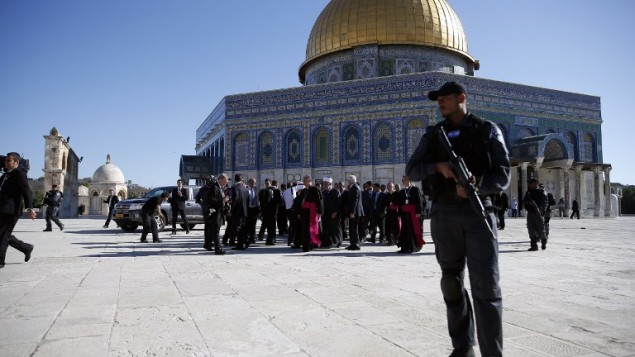
Flanked by a large phalanx of men in suits, Francis arrives on the Temple Mount, where he is being taken on a tour by the grand mufti of Jerusalem.
Francis enters the Dome of the Rock, at the heart of a site revered by Jews as the location of the first and second Temples as well as the Foundation Stone of the earth, and by Muslims as the site where the prophet Mohammed ascended to heaven.

Roads closed around Old City
With Pope Francis jaunting around town Monday, most Jerusalemites are gearing up for wide-ranging traffic delays across the capital.
The pope famously prefers an unarmored popemobile, meaning security officials, unwilling to take chances, plan on closing several roads around his route as he goes from the Old City to Mount Herzl and then to meetings with leaders before heading back to Mount Zion. In the morning, most police closures will center around approaches to the Old City as Francis makes the short commute between his Latin Patriarchate suite and the holy esplanade of the Temple Mount and the Western Wall. For now, police say closed roads are: Ben Adiyah, Rockefeller Square, Jericho Way and Mota Gur Ascent.
Pope Francis faces a diplomatic high-wire act on Monday as he visits sacred Muslim and Jewish sites in Jerusalem on the final day of his Middle East tour.
The pontiff is rounding off a whirlwind trip which saw him issue a unique invitation to Israeli President Shimon Peres and Palestinian Authority President Mahmoud Abbas to pray with him at the Vatican to end the “increasingly unacceptable” Israeli-Palestinian conflict, as well as snatching a personal moment at Israel’s controversial security barrier.
Francis had promised the three-day pilgrimage, which began on Saturday in Jordan, would steer clear of political issues. But he ad-libbed from his scripted speeches to condemn anti-Semitism, religious intolerance and those behind conflicts in the Middle East.

On Monday, Jews and Muslims are expected to scrutinize the pope’s every word and gesture as he seeks to bridge the religious divides in meetings with leaders from both sides.
The 77-year-old pontiff will meet the Grand Mufti of Jerusalem on the Temple Mount, Islam’s third holiest site, and the holiest in Judaism as the site of the Biblical temples. He will then pray at the Western Wall before visiting the Yad Vashem Holocaust memorial museum, where he will speak with Holocaust survivors, and will also become the first pope ever to lay flowers at Zionist visionary Theodor Herzl’s grave on Mount Herzl. The pope will also celebrate mass at the site known as the Cenacle, or Upper Room, bringing into sharp focus a decades-long debate over the site where Christians believe Jesus had his Last Supper. The site, on Mount Zion, is located in a two-story building also considered holy to Jews and Muslims, who regard it as the place where the biblical figure David was buried.
On Sunday, Francis celebrated mass in Bethlehem’s Manger Square amid thousands of cheering, flag-waving Christians.
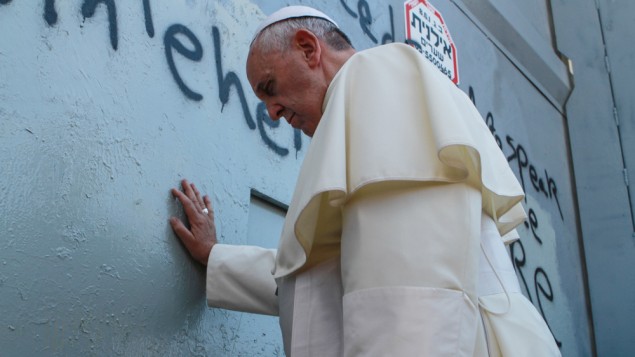
He also made an unscheduled stop by the West Bank security barrier, climbing out of his open jeep to pray, his forehead and hand resting against the wall, in a powerful show of support for the Palestinians.
At the end of the open-air mass, the pope weighed in on the Middle East conflict, inviting Abbas and Peres to join him at the Vatican for a “heartfelt prayer” for peace.
In the wake of the latest breakdown in US-led peace talks, Francis called on leaders to show “courage” to achieve a peace based on a two-state solution, saying “building peace is difficult, but living without peace is a constant torment.”
A senior Palestinian official confirmed Abbas had accepted and would visit the Vatican on June 6, while Peres’s spokesman said only that the invitation was welcomed. n a boost for relations between bickering Christians, Francis joined Orthodox Patriarch Bartholomew I in an historic joint prayer for unity between Rome and Constantinople.
The pair met, embraced and kissed at the Church of the Holy Sepulchre inside the walled Old City to mark the historic meeting 50 years ago between Pope Paul VI and Patriarch Athenagoras — the first easing of tensions between the Churches since the Great Schism in the 11th century.
Francis has said the main reason for Middle East visit was the meeting with Bartholomew I, and “to pray for peace in that land, which has suffered so much.” (AFP/Times of Israel staff)

 domhertz.com