
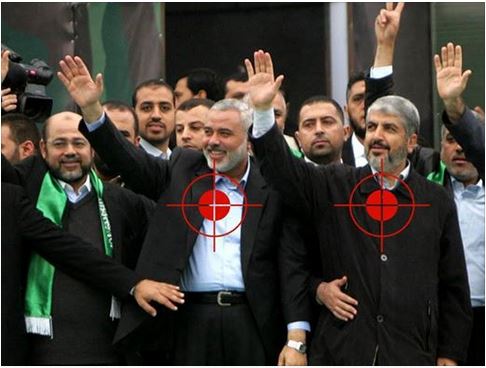

If Gaza terror chief was killed on Tuesday night,
Hamas will feel obligated to escalate the fighting;
If not, we may yet see a return to the Cairo talks.
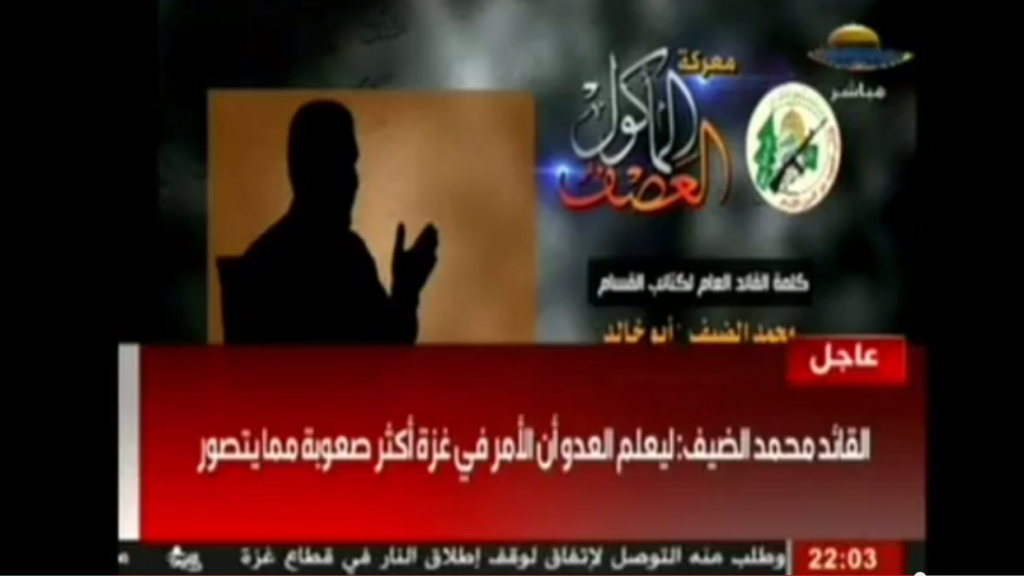
Izz ad-Din al-Qassam Brigades’s chief Muhammad Deif delivering a recorded address after a Hamas terrorist infiltration into Israel, July 30, 2014.
As of this writing, Hamas has not formally confirmed whether Muhammed Deif, the head of its military wing, survived Israel’s attempt to kill him at 9:30 on Tuesday night in Gaza’s Sheikh Radwan district. Hamas’s radio station, Al Aqsa, has tweeted that he’s alive, and that may prove to be the case. We shall see.
Reports from Gaza say the Israeli air force targeted the Dalo family home, where Deif’s family was. The building was hit by five missiles and all three of its floors collapsed. Hamas announced on Wednesday morning that Deif’s wife, Waded and his son Ali, were killed, as was Ahmed al-Dalo, 20. Hamas presented a document with Shifa hospital records, recording the time at which the bodies of Deif’s wife and son were brought in. Why did it take a long time for the bodies to be brought in? Hard to say.
In fact, there are quite a few questions about the targeting of Deif, apart from the central mystery of his fate. Was the attack carried out on the basis of firm and specific intelligence, or more general information to the effect that the Deif family was hiding out in Gaza City neighborhood far from the family home in Khan Younis refugee camp? The likelihood that Deif would be with his wife and son when the conflict had re-escalated does not seem particularly high, although quite a few highly wanted terrorists have paid the heaviest price for similar mistakes. Deif has indeed proved impressively capable of survival, but he was badly hurt in a previous Israeli attack and his survival on that occasion was not because of a wondrous capacity for hiding.

One well-known story in the upper echelons of the Shin Bet relates to the special connection between the head of the Hamas military wing in the West Bank, arch-terrorist Ibrahim Hamed, and his wife. Even at the height of the periods when Israel was seeking him most assiduously, he would send letters and gifts to her at considerable personal risk. She even became pregnant during that time. (Hamed was eventually caught, tried and convicted in 2012 of 46 murders, and is serving multiple life sentences in an Israeli jail.) That’s not to say that the same applies to Deif, but Hamas’s Gaza arch-terrorist has been wanted since the early 1990s. Presumably, he visits his wife and children every now and then. Otherwise, there wouldn’t be children.
Another issue concerns Israel’s considerations in attacking Deif at this juncture. This is not to say that it was not correct to target Deif, an arch-terrorist who turned himself into a dead man years ago. It’s the timing that raises questions.
Just hours earlier, Israel and Hamas had been in indirect negotiations, via Egypt and the Palestinian Authority, on a long-term truce. Rocket fire had begun on Tuesday afternoon with a salvo at Beersheba, but after that the rockets had tailed off. The Israeli decision to strike the house in Sheikh Radwan spelled certain escalation. And that might be a better decision than the continuation of hopeless negotiations. But if that was the case, then Israel should have cut the talks short and prepared for a widespread ground offensive, including the call-up of reservists. Whoever authorized the attempted assassination of Muhammed Deif knew that it meant continuation of the fighting and an escalation for several additional days at least.
The prospects for resumed negotiations in Egypt (with or without American involvement) now appear to depend, ironically, on the fate of Deif. If this symbol of Hamas has been killed, Hamas would feel the political need to escalate the fighting with a harsh response — to demonstrate to the Palestinian public that it was not surrendering. Thus, the likelihood of a truce or an arrangement in the coming days would be zero.
But if Deif has survived, the issue of revenge becomes personal, rather than political, and Cairo might again host another effort at indirect negotiations on a long-term deal.
Going ‘for the head’ of the octopus. 44 days on,
what is Israel’s policy for Gaza and how much war will suffice to achieve it?
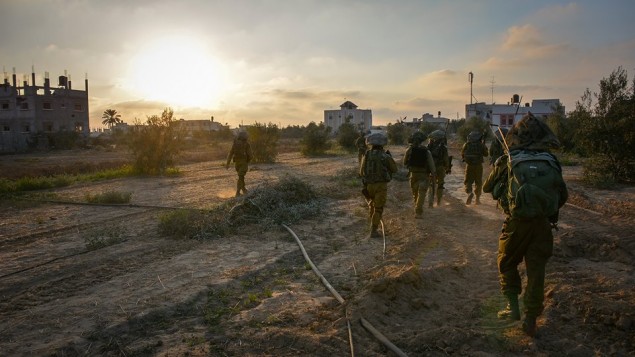
Israeli army troops operating in Gaza during Operation Protective Edge.
Prussian general Carl von Clausewitz famously determined that “war is merely the continuation of policy by other means.”
On Day 44 of Operation Protective Edge — with Israel striking targets in Gaza, rockets landing in Israel, and the cabinet, yet again, pondering the call-up of reserves and the possibility of a ground invasion — it must be asked: What, then, is Israel’s policy for Gaza and how much war will suffice to advance that policy?Here are some thoughts on that question, and other aspects of a conflict in which both sides are weary and neither is willing to compromise.
The cabinet seems fundamentally divided between those who wish to crush Hamas militarily; those who wish to create an international mechanism, whether by UN Security Council decree or by regional peace summit, that delivers, after the application of force, the reins to Mahmoud Abbas; and those, particularly at the apex of the political pyramid, who seek the perpetuation of the status quo, strengthening no one, siding with no one, and living, in periodic peace, under the roof of our deterrence.
These acute differences have likely played a role in the uncertain use of force in the Gaza Strip to date.
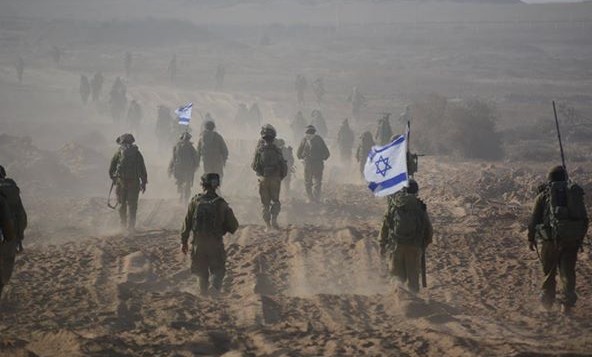
IDF troops leaving Gaza at the close of the ground operation earlier this August .
Ground invasion take 2.
If Israel chooses to re-invade Gaza, it will have to act decisively and deceptively. The organization will have to be rocked back on its heels and not struck precisely at the time and in the location it suspects. This, as The Times of Israel mentioned earlier in this campaign, aligns with the [Ariel] Sharon doctrine, which held that the post-1967 stories about Arab armies fleeing in the face of Israel, leaving their boots in the sand, were folly. “If you attack them the way they were trained,” the general and prime minister told his son Gilad on countless occasions, “they will fight to the death.”
Maj. Gen. (res) Uzi Dayan, a former national security adviser, has advocated for a ground invasion from the get-go. On Wednesday he said that Israel has been battling with the “arms of the octopus” – the tunnels, rockets, and anti-tank missiles. “I’d go for the head,” he said in a phone interview. “From the moment we decide on a ground invasion, I’d go for the head.”

Prime Minister Benjamin Netanyahu (right) former deputy chief of staff and national security adviser Uzi Dayan (center) and Defense Minister Ehud Barak (AP/Oded Balilty)
The Kryptonite of Hamas
It bears consideration, though, that the Kryptonite of Hamas and other jihadist organizations is not death but peace and prosperity.
Anyone living in Israel during the months after prime minister Yitzhak Rabin’s November 1995 assassination remembers the repulsive zeal of Hamas’s suicide attacks –
a feverish assault meant to bury the peace process that it and Yigal Amir, among others, helped kill.
Respect for Hezbollah, not for Hamas
The Israeli military has great respect for Hezbollah. While once the organization’s gunmen were known to walk in clumps, avoid helmets, and smoke cigarettes in the dark, today military intelligence officers, briefing reservists before heading up to the Lebanon border, say of Hezbollah camouflage positions that, “I hope you all can make ones like they do.”
It is understood that Hezbollah’s gunmen will fight to the death; that they will try not to leave their own wounded in the field; and that they will launch bold and complex attacks. The same, though, is not true of Hamas.
Israel still considers the Gaza Islamist organization’s gunmen cowardly terrorists. “Hamas had planned to stand and fight, but the Qassam Brigades proved unequal to the task,” Shin Bet commander Yoram Cohen wrote in a Washington Institute for Near East Policy article after 2008-2009′s Operation Cast Lead. “None of the [Izz ad-Din al-Qassam Brigades’] ground measures worked, and consequently they failed to match the public image Hamas had tried so hard to present of stalwart, proficient Islamic warriors.”
Cohen and co-author Jeffrey White contrasted Hamas warriors to Hezbollah and the Taliban, and said that, “not all Islamic warriors are larger than life, and in fact the Qassam Brigades in Cast Lead showed themselves to be quite the opposite.” This attitude, it would seem, is becoming increasingly less relevant.
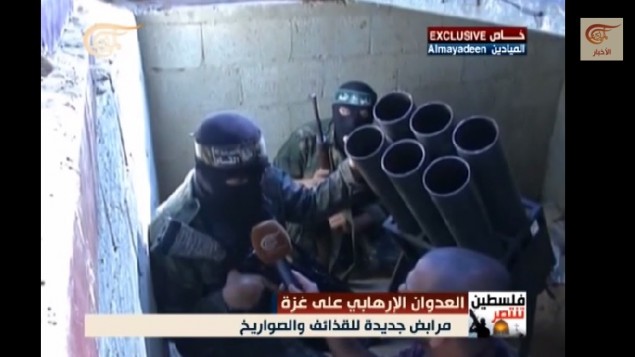
In footage captured by al-Mayadeen, apparently during the current truce, Hamas Izz ad-Din al-Qassam Brigades fighters are seen preparing rockets to launch against Israel in a tunnel underneath the Gaza Strip. (screen capture, YouTube)
Masks and morality
Philip Zimbardo is a psychologist. He has devoted much of his life to the study of how and why good people commit evil deeds. In 2004, he testified as a witness for the defense in one of the Iraq Abu Ghraib prison trials, arguing that, based on the harrowing Stanford prison study he conducted in 1971, anyone is capable of committing atrocities without proper training.
[The prison study had to be called off after six days on account of guard brutality and prisoner trauma.]
Appearance, too, plays an outsized role in one’s willingness to cross moral lines, he said during a 2008 TED talk. “Does it make a difference if warriors go to battle changing their appearance or not?” he asked. “Does it make a difference if they’re anonymous, in how they treat their victims? We know in some cultures, they go to war, they don’t change their appearance. In other cultures, they paint themselves like ‘Lord of the Flies.’ In some, they wear masks.”
An anthropologist, John Watson, studied 23 different cultures, he said, collecting two bits of data: do they change their appearance for battle and do they kill, torture or mutilate their victims. “If they don’t change their appearance,” he said, “only one of eight kills, tortures or mutilates…If they change their appearance, 12 of 13 — that’s 90 percent — kill, torture, mutilate. And that’s the power of anonymity.”
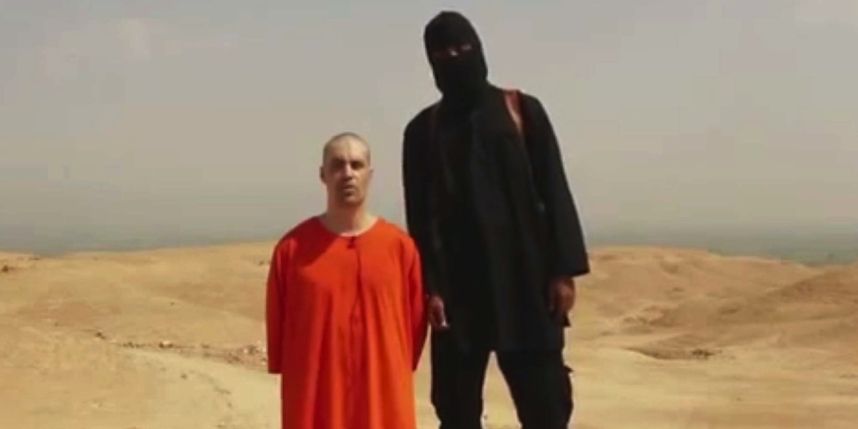
American journalist James Foley, kneeling in orange, in a video released by the Islamic State that apparently showed him being beheaded by his captor, August 19, 2014. (screen capture: YouTube/News of the World)
This lecture came to mind while watching the spokesmen of Hamas in their full facial coverage and the similarly outfitted executioners of the Islamic State.
Israel, though, has also begun outfitting Special Forces soldiers with black balaclavas. An army spokesperson could not say whether it was in order to preserve the anonymity of the soldiers or a safety measure or some other rationale. Nor is there a comparison to be made. But the IDF might want to take Zimbardo’s findings into consideration when outfitting its soldiers.

 domhertz.com
Grande qualit茅 New Balance Rose fluo Femmes
Write more, thats all I have to say. Literally, it seems as though you relied on the video to make your point. You clearly know what youre talking about, why throw away your intelligence on just posting videos to your site when you could be giving us something enlightening to read?
J’aimeJ’aime