


The Caliphate Brings Trauma
Without warning, the ancient and long powerless institution of the caliphate returned to life on June 29, 2014.
What does this event augur?
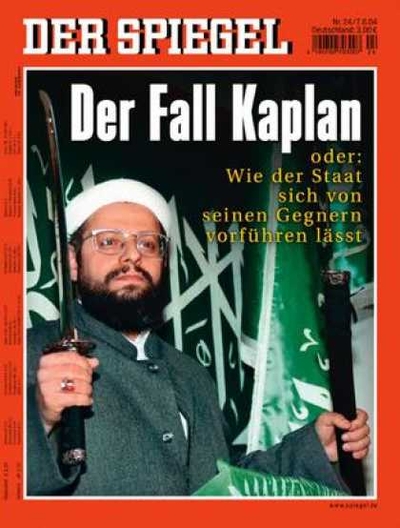
« The Kaplan Case, » a German magazine cover story about the « Caliph of Cologne. »
The classic concept of the caliphate – of a single successor to Muhammad ruling a unified Muslim state – lasted just over a century and expired with the emergence of two caliphs in 750 CE. The power of the caliphate collapsed in about the year 940 CE. After a prolonged, shadowy existence, the institution disappeared altogether in 1924. The only subsequent efforts at revival were trivial, such as the so-called Kalifatsstaat in Cologne, Germany. In other words, the caliphate has been inoperative for about a millennium and absent for about a century.
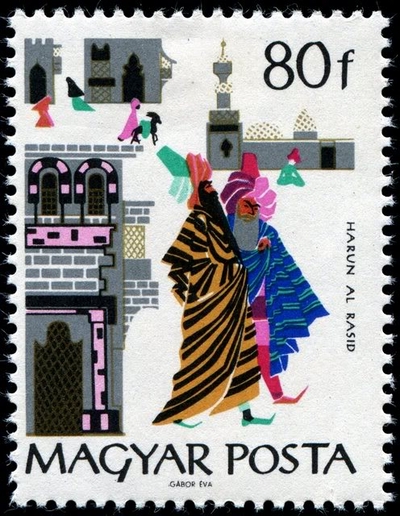
Harun al-Rashid as imagined in a 1965 Hungarian stamp.
The group named the Islamic State in Iraq and Syria
conquered the city of Mosul, population 1.7 million, in June; days later, it adopted the name Islamic State and declared the return of the caliphate. Its capital is the historic town of Raqqa, Syria (population just 220,000), which not-coincidentally served as the caliphate’s capital under Harun al-Rashid for 13 years. Under the authority of an Iraqi named Ibrahim Awwad Ibrahim, the new caliphate projects boundless ambition to rule the entire world (« east and west ») and to impose a uniquely primitive, fanatical, and violent form of Islamic law on everyone.

I have predicted that this Islamic State, despite its spectacular rise, will not survive: « confronted with hostility both from neighbors and its subject population, [it] will not last long. » At the same time, I expect it will leave a legacy:
No matter how calamitous the fate of Caliph Ibrahim and his grim crew, they have successfully resurrected a central institution of Islam, making the caliphate again a vibrant reality. Islamists around the world will treasure its moment of brutal glory and be inspired by it.
Looking ahead, here is my more specific forecast for the current caliphate’s legacy:
1. Now that the ice is broken, other ambitious Islamists will act more boldly by declaring themselves caliph. There may well be a proliferation of them in different regions, from Nigeria to Somalia to Afghanistan to Indonesia and beyond.
2. Declaring a caliphate has major implications, making it attractive to jihadis across the umma (the worldwide Muslim community) and compelling it to acquire sovereign control of territory.
3. The Saudi state has taken on a quasi-caliphal role since the formal disappearance of the Ottoman caliphate in 1924. With the emergence of the Raqqa caliphate, the Saudi king and his advisors will be sorely tempted to declare their own version. If the current « Custodian of the Two Holy Mosques » (as the Saudi king like to be called), who just turned 90, does not indulge this claim, his successors might well do so, thereby becoming the first caliphate in a recognized state.
4. The Islamic Republic of Iran, the great Shi’ite power, might well do the same (calling it an imamate), not wanting to be conceptually out-gunned by the Sunnis in Riyadh, thus becoming the second formal caliphal state.
5. This profusion of caliphs will further exacerbate the anarchy and internecine hostility among Muslim peoples.
6. Disillusion will quickly set in. Caliphates will not bring personal security, justice, economic growth, or cultural achievement. One after another, these self-declared universal states will collapse, be overrun, or let lapse their grandiose claims.
7. This caliphate-declaring madness will end some decades hence, with a return to roughly the pre-June 29, 2014, conditions. Looking back then on the caliphal eruption, it will appear as an anachronistic anomaly, an obstacle to modernizing the umma, and a bad dream.
In short, declaring the caliphate on June 29 was a major event; and the caliphate is an institution whose time has long passed and, therefore, whose revival bodes much trauma.
Pope Benedict XVI (right) met in 2007 with Saudi king (and future Caliph?) Abdullah.Caliph Ibrahim’s Brutal Moment
After an absence of 90 years, the ancient institution of the caliphate roared back into existence on the first day of Ramadan in the year 1435 of the Hegira, equivalent to June 29, 2014. This astonishing revival symbolically culminates the Islamist surge that began forty years ago. A Western analogy might be declaring the restoration of the Hapsburg Empire, which traced its legitimacy to ancient Rome.
Whence comes this audacious move? Can the caliphate last? What will its impact be?
For starters, a quick review of the caliphate (from the Arabic khilafa, meaning « succession »): according to canonical Muslim history, it originated in 632 CE, on the death of the Islamic prophet Muhammad, then spontaneously developed, filling the nascent Muslim community’s need for a temporal leader. The caliph became Muhammad’s non-prophetic heir. After the first four caliphs, the office became dynastic.
From the start, followers disagreed whether the caliph should be the most able and pious Muslim or the closest relative of Muhammad; the resulting division came to define the Sunni and Shi’i branches of Islam, respectively, causing the profound schism that still endures.
A single caliphate ruled all the Muslim lands until 750; but then two processes combined to diminish its power. First, remote provinces began to break away, with some – such as Spain – even creating rival caliphates. Second, the institution itself decayed and was taken over by slave soldiers and tribal conquerors, so that the original line of caliphs effectively ruled only until about 940. Other dynasties then adopted the title as a perquisite of political power.
The institution continued in an enfeebled form for a millennium until, in a dramatic act of repudiation, modern Turkey’s founder, Kemal Atatürk, terminated its last vestiges in 1924. Despite several subsequent attempts to restore it, the institution became defunct, a symbol of the disarray in Muslim-majority countries and a yearned-for goal among Islamists.
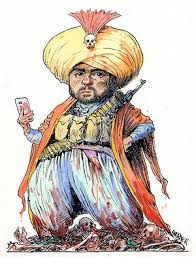
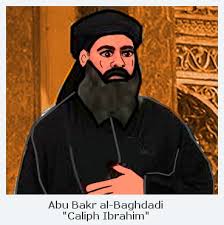
And so matters remained for 90 years, until the group known as the Islamic State in Iraq and Syria (ISIS) issued a declaration in five languages (English version: This Is the Promise of Allah) proclaiming the founding of a new caliphate under « Caliph » Ibrahim. Caliph Ibrahim (aka Dr. Ibrahim Awwad Ibrahim), about 40, hailing from Samarra, Iraq, fought in Afghanistan and then Iraq. He now claims to be leader of « Muslims everywhere » and demands their oath of allegiance. All other Muslim governments have lost legitimacy, he claims. Further, Muslims must throw out « democracy, secularism, nationalism, as well as all the other garbage and ideas from the West. »
Caliph Ibrahim preaching in a Mosul mosque in early July 2014.Reviving the universal caliphate means, announces The Promise of Allah, that the « long slumber in the darkness of neglect » has ended. « The sun of jihad has risen. The glad tidings of good are shining. Triumph looms on the horizon. » Infidels are justifiably terrified for, as both « east and west » submit, Muslims will « own the earth. »
Grandiloquent words, to be sure, but also ones with zero chance of success. ISIS has enjoyed backing from states like Turkey and Qatar – but to fight in Syria, not to establish a global hegemony. Nearby powers – the Kurds, Iran, Saudi Arabia, Israel
(and eventually maybe Turkey too*) – regard the Islamic State as an unmitigated enemy,
as do nearly all rival Islamic movements, including Al-Qaeda.
(The only exceptions: Boko Haram; scattered Gazans; and a new Pakistani organization.)
The caliphate already faces difficulty governing the Great Britain-sized territories it conquered, troubles that will increase as its subject populations experience the full misery of Islamist rule.
(Its apparent capture of the Mosul Dam on Aug. 3 portends unspeakable crimes,
including the denial of electricity and water; or even creating catastrophic floods.)I predict that the Islamic State, confronted with hostility both from neighbors and its subject population, will not last long.
It will leave a legacy, though. No matter how calamitous the fate of Caliph Ibrahim and his grim crew, they have successfully resurrected a central institution of Islam, making the caliphate again a vibrant reality.
Islamists around the world will treasure its moment of brutal glory and be inspired by it.
For non-Muslims, this development has complex and double-edged implications. On the negative side, violent Islamists will be more encouraged to achieve their hideous goals, leaving a wake of carnage. On the positive side, the caliphate’s barbaric zealotry will have the salutary effect of awakening many of those yet asleep to the horrors of the Islamist agenda.
The new caliph has a message for you
On June 29, 2014, the Islamic State of Iraq and the Levant (ISIL or ISIS)
established the new Islamic Caliphate.
The new caliph is Abu Bakr Al-Husayni al-Qurashi al-Baghdadi.
He’s now known as Caliph Ibrahim.
There are conflicting accounts of when we had him in custody.
The more colorful story is given by the former commander of Camp Bucca in Iraq,
Colonel Kenneth King. He says Caliph Ibrahim was released in 2009, and as he left he said, “I’ll see you guys in New York.” However, there are no Defense Department records of him being in custody after December of 2004. I’ve come to the sad conclusion that most people love attention from journalists, so they’ll say anything to get their mugs on TV.
At any rate, ISIL now calls itself the Islamic State, and Caliph Ibrahim has issued his first communique. Before I get to that, you need to know something about Islam.
Sharia—Islamic law—divides the world into two territories: Dar al-Islam, the Abode of Submission; and Dar al-Harb, the Abode of War. We non-Muslims must choose between submission to Islam or war. It took me a while to find a definition of the term that Muslim apologists couldn’t dispute. Note that the Oxford link says the following.
Like other classical legal concepts, dar al-harb has been affected by historical changes, and with the fragmentation of the Muslim world into numerous states, the concept has little significance today.
That’s a comforting fantasy, but the notion of Dar al-Harb is the precise reason Muslims are attacking non-Muslims all over the world. In fact Caliph Ibrahim of the new Caliphate talks about it.
“Slaves of Allah.” Makes you want to join right up, doesn’t it?
And there is no deed in this virtuous month or in any other month better than jihad in the path of Allah, so take advantage of this opportunity and walk the path of your righteous predecessors. Support the religion of Allah through jihad in the path of Allah. Go forth, O mujahidin in the path of Allah. Terrify the enemies of Allah and seek death in the places where you expect to find it, for the dunyā (worldly life) will come to an end, and the hereafter will last forever.
Very straightforward language. The good news is that they’re seeking death. We should accommodate them. Designate the Caliphate the “Abode of War Ordnance Proving Ground.” Anybody who doesn’t want to submit to Islam can test their new weapons there. The jihadis get what they want—a double helping of piping-hot death—and those who prefer to not be slaves of Allah learn which of their devices send the most murderous cavemen to their eternal reward.







 domhertz.com