

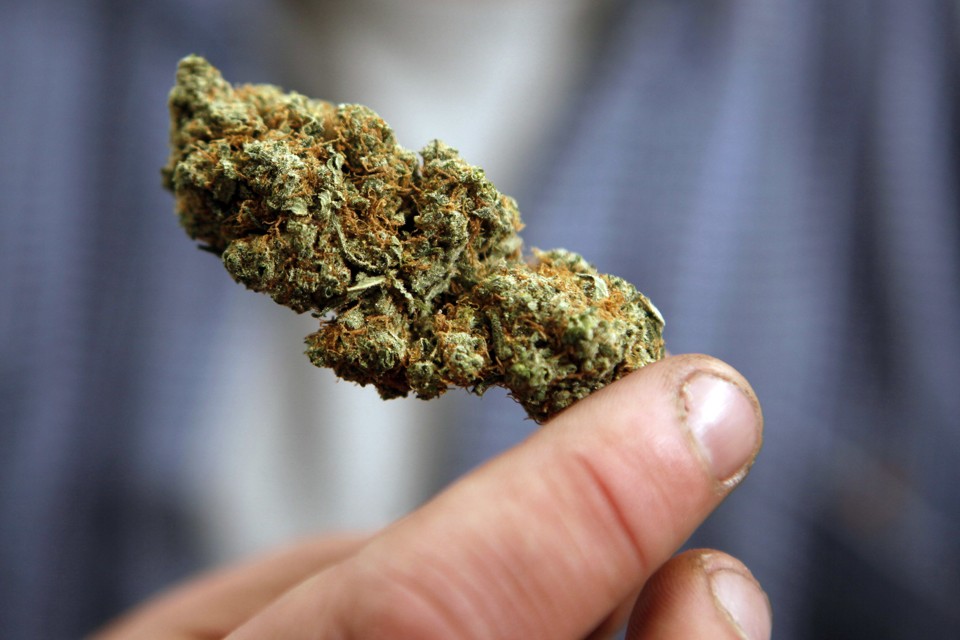
 Recreational marijuana users can now legally light up a joint in states representing about 5 percent of the U.S. population. By the time Americans wake up on November 9, that percentage could be swelling to more than one-quarter.Measures to legalize and regulate the sale of cannabis are on the ballot in California, Arizona, Massachusetts, Maine, and Nevada, and recent polls show the “yes” vote is winning in all five states. Approval would mark the biggest advance yet for advocates in the decades-long fight over legalizing marijuana—one that they believe could ultimately force the federal government to end its prohibition of the drug.

“On November 8, you can safely say we’ve reached the tipping point if these go our way,” said Tom Angell, founder of the group Marijuana Majority. The most important battleground is California, where advocates expect voters to approve personal use of pot six years after they defeated a similar measure. Support for Proposition 64 is polling at nearly 60 percent, and the measure has drawn support from leading politicians and newspapers that opposed it in 2010, including Democratic Lieutenant Governor Gavin Newsom. The leading candidate for California’s open Senate seat, Kamala Harris, predicted Wednesday that voters would approve the law, although as the state’s attorney general she can’t formally take a position.

Why Congress Gave In to Medical Marijuana.
Congress may have tried to stop residents of the nation’s capital from being able to light up joints with impunity, but lawmakers retreated last week in another important drug-war front: medical marijuana.

The $1 trillion spending bill that passed last week included a provision that blocks the Justice Department from spending any money to enforce a federal ban on growing or selling marijuana in the 23 states that have moved to legalize it for medical use. It marks a huge shift for Congress, which for years had sided with federal prosecutors in their battle with states over the liberalization of drug laws. « The war on medical marijuana is over, » Bill Piper, a lobbyist with the Drug Policy Alliance.

Another leading advocate of legalization, Allen St. Pierre of NORML, was pleased but not quite so jubilant. After all, under President Obama, the Justice Department in the last five years has sharply curtailed its raids on pot growers and sellers. But directives from Washington, he said, had not stopped overzealous prosecutors and DEA agents in parts of California from targeting the largest marijuana dispensaries. Will they follow Congress but not the president? « They will decide whether this comes to be, » St. Pierre said by phone, in reference to the prosecutors and the DEA.

« The war on medical marijuana is over. »
Representative Dana Rohrabacher, a Republican from California, was one of the authors of the medical-use provision, and he made the case to his colleagues on grounds that many conservatives can understand: states’ rights. In a statement, he said his amendment would force the federal government to « respect state sovereignty » on the question of medical marijuana.

St. Pierre, however, says the shift is more generational. As Baby Boomers and their children have come to occupy positions of power across all levels of government, opposition to a strict marijuana prohibition has dropped. « There’s almost a fait accompli, » he said. A poll by the Third Way think tank in September found that while the country is still split on recreational marijuana, more the three-quarters—78 percent—support legal pot use for medical purposes. It might not do much for Congress’s dismal approval rating, but on this issue at least, lawmakers appear to be following the public.

Medical marijuana has been legal in California for 20 years, and sanctioning its use more widely would surely exacerbate tensions with the Drug Enforcement Administration and Congress over enforcement of federal laws classifying cannabis as a drug. “Passing legalization in California will greatly accelerate our ability to end the federal prohibition,” Angell predicted in a phone interview on Thursday. Keith Stroup, the founder of pro-marijuana lobbying group NORML, said he believed victory in California would signal a point of no return for the legalization movement. “California is almost a nation-state,” he said. “Once we get California, other than to water down future proposals, I don’t think [opponents] will be able to defeat them.”

Congress in 2014 passed legislation barring the Justice Department from spending money to endorse federal laws against marijuana in states that have legalized the drug for medical purposes, and a federal appeals court in August upheld the congressional directive. An amendment to prohibit the Justice Department from prosecuting recreational marijuana use in states that have sanctioned it fell just nine votes short of passage in the Republican-controlled House. Before 2014, the Justice Department had continued launching raids on medical-marijuana dispensaries even in states where they’re legal, and while the feds don’t typically go after average users, the amendment would’ve prevented them from raiding shops and growers who are abiding by state laws.


“Passing legalization in California will greatly accelerate our ability to end the federal prohibition.”

In addition to the full legalization measures, voters in four other states—Florida, Montana, North Dakota, and Arkansas—are considering laws approving medical marijuana. Supporters are confident about their chances in Florida but are less certain in Montana and North Dakota, where there has been little polling on the issue. They are most concerned about Arkansas because there are two medical-marijuana measures on the ballot—one supported by the legalization movement and another that is considerably narrower and more restrictive. “There’s a concern that voters will simply vote their favorite medical-marijuana measure and split the vote,” Angell said.

Legalization advocates view the opposition strategy from Sabet’s group as confirmation of the increasing support for marijuana—and disingenuous. SAM describes itself as promoting a “third way” that “neither legalizes nor demonizes” marijuana use. But as Stroup points out, they have opposed medical-marijuana initiatives and laws like the one approved in Washington, D.C., that strictly limits how much pot people can grow or carry.

Another worry, Angell said, is complacency and overconfidence among marijuana advocates. Contrary to Sabet’s claims, he complained that the marijuana industry was not contributing enough to the legalization drive—and indeed, the medical-marijuana community in California is reportedly divided over the ballot measure in part because small growers view it as a boon to big business, according to the Los Angeles Times. The California Growers Association, for example, decided to stay neutral on the proposal. “There’s almost this sense that marijuana will legalize itself, that we’ve already won,” Angell said. If victories this year could put legalization on a nationwide path, losses would be a momentum killer. “A lot,” he admitted, “is riding on this.”


 domhertz.com